.svg)

.svg)
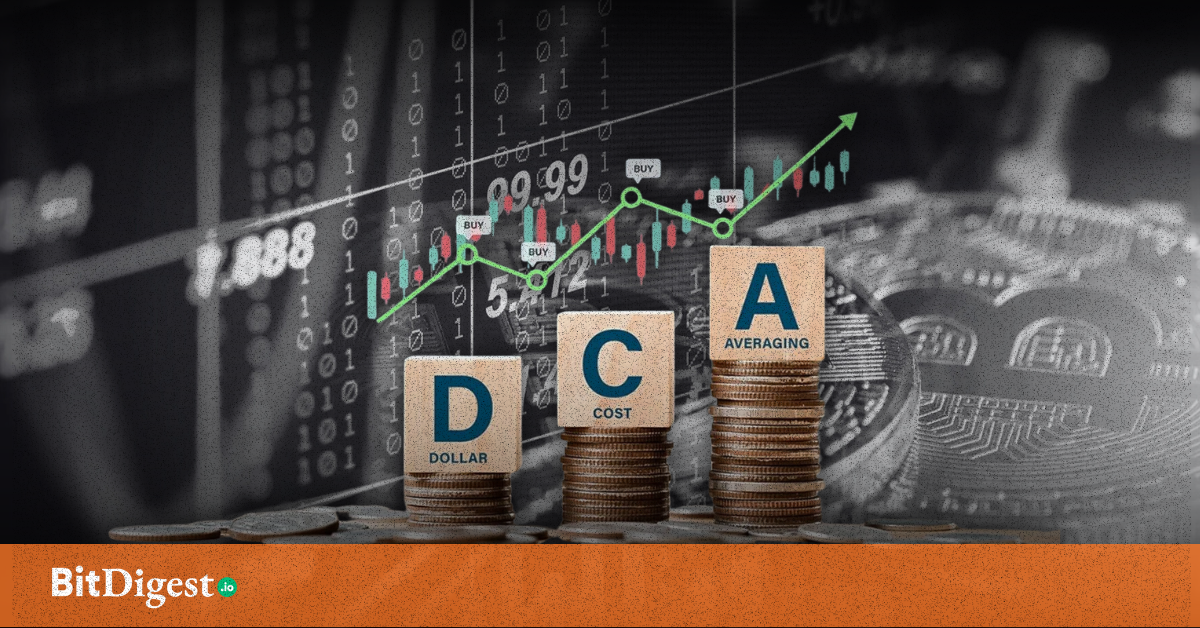
DCA in Crypto: What New Traders Should Know

If you’ve ever stared at a Bitcoin chart and thought, “What if I buy now and it dumps tomorrow?” you’re not alone. The hardest part of getting into crypto isn’t usually what to buy, it’s when to buy.
That’s where dollar-cost averaging, or DCA, comes in. Long before crypto, traditional investors used DCA to build positions in stocks and index funds without trying to perfectly time the market. Now the same idea is being applied to digital assets, often with the help of automated tools and trading bots on exchanges like OKX.
What DCA really is (in normal language)
Instead of putting ₱100,000 into an asset all at once, you might decide to invest ₱10,000 every month for 10 months; regardless of whether the price is up, down, or sideways.
Over time, those separate buys happen at different price points. Some months you buy higher, some months lower, and what you end up with is an average entry price instead of a single all-in bet at one moment.
The idea isn’t to beat the market with clever timing. It’s to reduce the risk of being wrong about timing. If you buy everything at once and the market drops 30% the next week, that hurts. If you’re averaging in over many weeks or months, short-term swings matter less because you’ve spread your entries over time.
Two important truths about DCA:
- It reduces timing risk, not asset risk. If you DCA into a terrible asset that trends to zero, the strategy doesn’t save you, it just gets you to zero in a smoother line.
- It works best when you believe the asset has a long-term future.
For many people, that’s Bitcoin or Ethereum: assets they expect to still matter years from now, even if prices are volatile along the way.
Why DCA is attractive in crypto
Crypto is exactly the kind of market where DCA appeals to beginners and cautious builders:
- Prices can swing double-digit percentages in a single day.
- Nobody can predict the “bottom” with certainty.
- People often have regular income (salary, side gig) rather than one huge lump sum.
If you think, “I want some exposure to BTC or ETH, but I don’t trust myself to time it,” DCA gives you a way to participate without obsessing over every dip and pump.
That said, there are obvious ways to misuse it:
- DCA-ing into whatever altcoin is trending on TikTok.
- Averaging into positions you only learned about yesterday.
- Committing to a schedule you can’t financially sustain.
So the first question isn’t “What bot should I use?” It’s “Do I actually understand and believe in the asset I’m DCA-ing into?”
What is a trading bot, really?
Now layer in automation. A trading bot is just software that follows a set of rules you define and executes trades on your behalf.
If you’ve ever thought, “I want to buy ₱2,000 worth of BTC every Monday at 9 p.m., but I forget or get busy,” that’s exactly the kind of thing a bot can handle.
Bots aren’t magic. They don’t have secret knowledge about where the market will go. They don’t “print money while you sleep.”
What they do well:
- Remove emotion from execution.
- Enforce your plan consistently, even when fear or greed kicks in.
- Run 24/7 so you don’t have to constantly watch the charts.
If your underlying strategy is reasonable, automation makes it easier to stick to it. If your strategy is reckless, a bot will happily be reckless on your behalf — just faster and more consistently.
Three flavors of DCA on OKX: from beginner to advanced
On exchanges like OKX, DCA shows up in different forms. They all share the same basic idea—building or adjusting positions over time—but the risk profiles are very different.
You can think of them in three layers:
1. Recurring Buy: classic, simple DCA
This is the most beginner-friendly version.
You choose:
- The asset (say BTC or ETH),
- The amount per interval,
- The schedule (daily, weekly, monthly, etc.).
The bot then automatically buys that amount on schedule, regardless of price. It doesn’t try to be clever. It just executes your plan.
This is the closest to traditional “set and forget” DCA used in stock and ETF investing. For someone new to both crypto and trading, this is usually where it makes sense to start — if you already have conviction in the asset and you’re thinking in years, not days.
2. Spot DCA (Martingale): more aggressive averaging
The next step up on OKX is the Spot DCA (Martingale) bot.
It still operates on the idea of averaging in as price moves, but with a twist: when the market moves against your position, the bot increases the size of the next order instead of keeping it fixed.
Example (simplified):
- You buy a bit of BTC.
- Price drops by a preset percentage.
- The bot buys more—often a multiple of the previous size—to drag your average entry price lower.
- If the price eventually rebounds to your take-profit target, the whole batch of buys can close in profit.
This can work in volatile, mean-reverting markets where prices often snap back after drops. But it comes with obvious risk: if the market keeps falling and you keep increasing size, your exposure grows faster than you might expect.
Here, you’re still in the spot market (no leverage by default), but the Martingale logic makes this more suitable for traders who understand drawdowns, have a clear max capital they’re willing to commit, and are prepared for the possibility that the market simply doesn’t bounce when they expect.
3. Futures DCA (Martingale): strictly advanced territory
The most complex variant in OKX’s lineup is the Futures DCA (Martingale) bot.
Mechanically, it behaves similarly to the Spot Martingale version: it adds to losing positions at predefined steps in an effort to lower your average entry and exit at a profit on a rebound.
The big difference: it operates in the futures market, where you can use leverage, in some cases up to 100x.
Leverage means you can control a much larger position with a relatively small amount of collateral. It also means price moves are magnified in both directions, and liquidation can happen quickly if you’re on the wrong side of a trend.
Combine that with Martingale logic, and you’ve got a tool that can be very powerful in the hands of experienced traders… and very dangerous for people still figuring out the basics.
If you’re new to crypto, or even just new to derivatives, this is not the first stop. Futures DCA (Martingale) should only be considered after you’ve fully understood how margin and liquidation work, how much capital you’re truly willing to lose, and how to set strict stop-loss parameters.
What traders should know before turning any DCA bot on
Whether you’re using a simple recurring buy schedule or a more complex Martingale structure, the questions you ask yourself up front matter more than which buttons you click.
A few grounding principles:
1. Start with the asset, not the bot.
If you wouldn’t be comfortable holding an asset for several years, think carefully before setting up a DCA plan for it. The strategy works best with assets you genuinely believe have staying power.
2. Decide your total budget and time frame first.
Instead of “I’ll DCA until I feel like stopping,” be specific: “I’ll invest ₱X over Y months,” and then design your DCA settings to match that plan.
3. Match the tool to your experience level.
For many people, a basic Recurring Buy into BTC or ETH is already a meaningful step. You don’t unlock “extra rewards” for jumping straight into high-leverage Martingale futures bots; you just unlock more ways to get liquidated.
4. Automation doesn’t replace risk management.
Even with bots, it’s on you to:
- Monitor performance occasionally,
- Adjust parameters when your situation changes,
- And be honest about your risk tolerance.
DCA is one of the simplest bridges between traditional investing habits and the world of crypto. It doesn’t eliminate risk, but it offers a structured way to build exposure in a market where prices move fast and emotions run hot.
On exchanges like OKX, that idea shows up in different forms:
- A straightforward Recurring Buy for long-term accumulation,
- More aggressive Spot DCA (Martingale) tools for active spot traders,
- And advanced Futures DCA (Martingale) bots for those who already understand leverage, drawdowns, and liquidation risk.
For new traders, and especially for people entering crypto for the first time—the goal isn’t to find the most complex bot. It’s to choose a simple, understandable plan, and then use automation to stick to it.
If you treat DCA as a strategy first and the bot as a helper second, you’re already ahead of most people who rush in the other way around.
.svg) SHARE TO FACEBOOK
SHARE TO FACEBOOK SHARE TO TWITTER/X
 SHARE TO LINKEDIN
 SEND TO MAIL



.svg)


.svg)