.svg)

.svg)
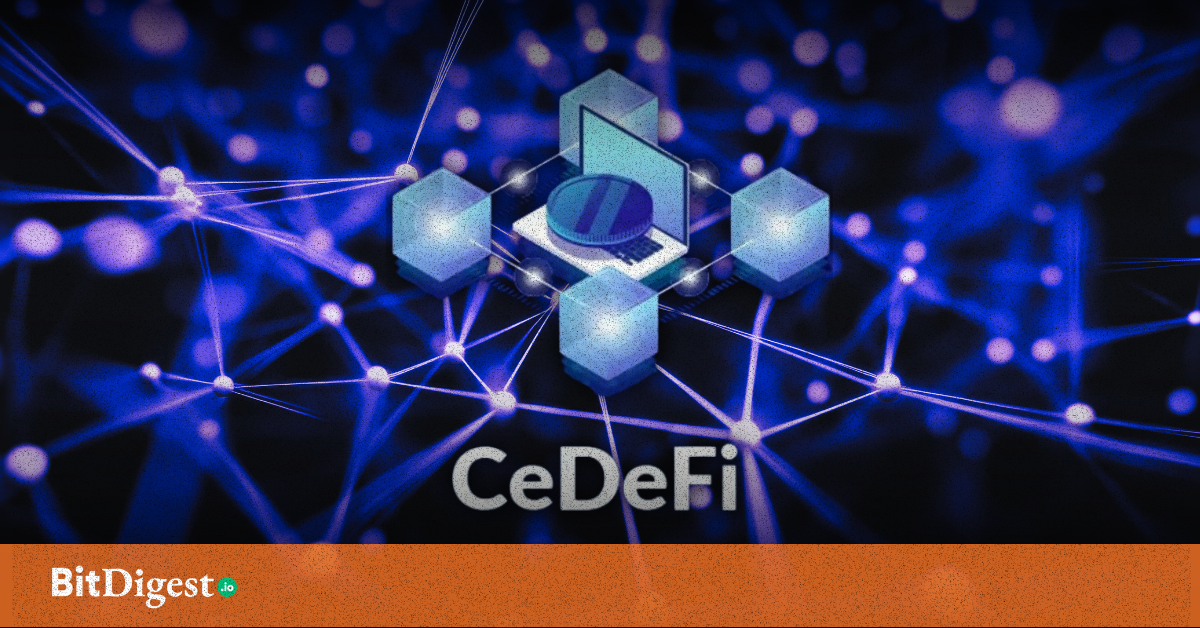
How CeDeFi Brings Earning, Hedging, and Automation Under One Roof

For years, DeFi has promised a more open, more powerful alternative to traditional finance, offering direct access to yield, advanced trading tools, and a borderless ecosystem. But for the average user, the reality has often been far messier: scattered interfaces, high gas fees, risk of slippage or error, and a reliance on third-party bridges that can break or be exploited.
The result? Many users either give up before they get started, or stick to centralized exchanges for simplicity, even if it means missing out on some of DeFi’s most compelling opportunities.
A new class of platforms is trying to change that. CeDeFi, or centralized-decentralized finance, is emerging as a hybrid solution that lets users earn, hedge, and automate without leaving the safety and simplicity of a single app.
What Is CeDeFi and Why It’s Gaining Traction
CeDeFi, short for centralized-decentralized finance, refers to a hybrid model that merges the accessibility of decentralized finance with the usability and infrastructure of centralized platforms.
Unlike pure DeFi, which often requires users to manage multiple wallets, bridge assets, and handle gas fees manually, CeDeFi offers a simplified experience through a single platform. Users gain access to decentralized markets and self-custody tools, but within a controlled environment that handles backend complexity like smart routing, market aggregation, and recovery options.
This model is gaining traction because it lowers the technical barrier to entry while retaining key DeFi principles: asset transparency, on-chain access, and user control.
Case Example
For instance, OKX recently launched an in-app DEX feature that integrates decentralized markets directly into its centralized exchange interface. This includes support for networks like Solana, Base, and X Layer, with no external wallets or bridges required.
Users can create passkey-based self-custody wallets in-app—skipping seed prases—and begin trading, staking, or swapping across more than 100 liquidity pools. The interface routes orders using smart aggregation tools, searching for best prices and minimizing slippage.
Most notably, users can see and manage all CeFi and DeFi assets in one portfolio, with unified history and controls; eliminating the need to switch apps or juggle platforms just to move capital around.
One App, Three Power Moves: Automate, Earn, Hedge
What makes this approach powerful isn’t just convenience. It’s the fact that it directly supports the core actions that make DeFi attractive in the first place, and makes them available in a way users can actually use.
Automate
With CeDeFi, users don’t have to manually bridge assets or monitor gas fees. Smart routing and one-click swaps simplify what used to take multiple tools. Some platforms are already exploring one-tap strategy execution and recurring DeFi actions—making automation viable even for retail users.
Earn
From early token listings to yield opportunities and staking products, CeDeFi platforms provide access to returns that might otherwise be buried under layers of friction. And because the setup is unified, users can reallocate capital quickly across chains or between markets.
Hedge
More active users can shift between spot markets, decentralized swaps, and even futures without ever leaving the app. This reduces latency and improves control, especially when managing exposure during fast market moves.
Why This Matters for Regular Users
CeDeFi could be a key enabler for broader DeFi adoption. By reducing the number of apps, wallets, and steps involved in simple actions, it brings powerful tools into reach for people who otherwise wouldn’t bother.
More importantly, self-custody is preserved, but paired with guided flows, recoverable passkeys, and an interface that helps reduce user error. It doesn’t ask users to trust blindly, but rather makes trust easier to verify.
That kind of confidence and access is what DeFi has been missing for many.
Caveats
As with anything in crypto, there’s no silver bullet. CeDeFi users still need to understand what they’re trading, where yield comes from, and what risks might be involved.
Smart contracts can still carry vulnerabilities. New tokens may lack liquidity. And the convenience of integration doesn’t eliminate the need for careful due diligence on asset quality or platform policies.
Transparency, including proof of reserves, open-source tooling, and clear documentation on wallet mechanics, remains essential for platforms offering this model.
CeDeFi positions itself as a necessary model to improve not just ease, but also said expanding access to advanced financial tools while reducing the opportunity for user error, complexity, or loss.
For millions of people who have never ventured beyond CeFi, it offers an on-ramp that doesn’t compromise on custody, control, or opportunity. CeDeFi may prove itself to be Web3’s next biggest thing, where automation, earning, and hedging are increasingly core to how traders operate; the ability to do it all in one place, safely and smoothly, may be more than a feature.
.svg) SHARE TO FACEBOOK
SHARE TO FACEBOOK SHARE TO TWITTER/X
 SHARE TO LINKEDIN
 SEND TO MAIL



.svg)


.svg)