.svg)

.svg)
Trusted Platforms Begin Embedding AI Into Execution with Agents Turned Onchain Operators

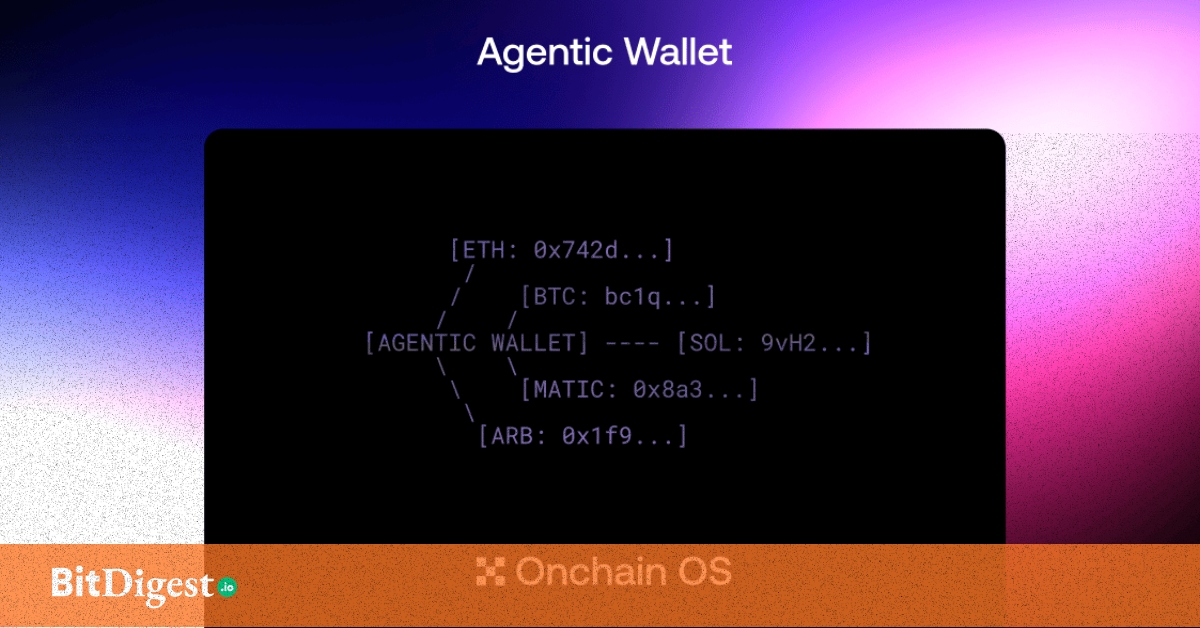
AI has rapidly evolved into a powerful tool for analyzing markets, generating strategies, and assisting users, but its role has largely stopped at recommendation. Across the crypto industry, that boundary is beginning to shift. A growing number of platforms are now exploring how AI can move beyond advisory functions into actual execution, integrating agent-driven capabilities directly into their systems. One of the latest examples is OKX, which has introduced an “agentic” wallet designed to let AI systems interact with blockchain networks and carry out transactions autonomously.
At its core, the development reflects a deeper transition in how crypto infrastructure is being designed. While trading interfaces and wallets have historically been built for human interaction—requiring manual approvals, key management, and step-by-step execution—AI introduces the possibility of continuous, automated participation. The challenge has been enabling that shift without compromising security.
From Insight to Execution
For years, AI tools in crypto have primarily functioned as overlays, helping users interpret data, identify trends, or simulate strategies. But execution has remained a human bottleneck, requiring users to translate insights into action across multiple platforms and chains.
The emergence of agent-based wallets signals an attempt to close that gap. Instead of simply recommending what to do, AI systems can now be configured to act on predefined goalswhether that involves rebalancing a portfolio, responding to market conditions, or interacting with decentralized finance protocols. Instructions can be expressed in natural language, allowing developers and users to define strategies without building complex smart contracts or custom scripts. This effectively turns AI from a decision-support layer into an operational layer—one capable of moving assets, not just analyzing them.
Controlled Autonomy as a Design Principle
Enabling AI to execute financial actions introduces obvious risks, particularly in an environment as fast-moving and irreversible as crypto. As a result, current implementations are being designed with multiple layers of constraint.
Transactions are typically simulated before execution, with outcomes translated into plain-language summaries that make actions easier to interpret. Risk scoring systems add another checkpoint, allowing higher-risk operations to be flagged or blocked altogether.
Security remains a central concern. In the case of OKX’s implementation, private keys are generated and stored within a Trusted Execution Environment (TEE), a hardware-isolated system that prevents exposure to both the AI agent and external systems. This approach attempts to maintain self-custody while reducing the vulnerabilities associated with automated access.
A New Layer in Crypto Infrastructure
The broader significance of this shift lies in its potential to reshape how users interact with crypto altogether. If AI agents can operate continuously across multiple networks, the experience of managing assets could move away from manual interaction toward background automation. Tasks such as portfolio management, yield optimization, and cross-chain execution—currently fragmented and time-intensive—could be handled by software operating in real time.
For developers, this also lowers the barrier to building more advanced applications. Instead of stitching together wallet infrastructure, transaction logic, and multi-chain compatibility, they can focus on defining intent; leaving execution to integrated systems. This positions AI not just as a feature, but as a new interface layer for Web3, sitting between users and the underlying protocols.
Competition Is Shifting Beyond Trading
The move also highlights a broader evolution in how exchanges are competing. Historically, differentiation has centered on liquidity, fees, and product offerings. Increasingly, however, platforms are investing in infrastructure that extends beyond trading; tools that support developers, enable automation, and integrate emerging technologies like AI.
By embedding these capabilities directly into their ecosystems, exchanges are positioning themselves as foundational layers for the next phase of crypto usage, where interaction is less about clicking through interfaces and more about delegating tasks to intelligent systems.
Risks, Limitations, and Early-Stage Realities
Despite the promise, agent-driven execution introduces new complexities. Autonomy reduces friction, but it also shortens the distance between decision and consequence. Errors—whether from flawed strategies, incorrect inputs, or unexpected AI behavior—can be executed instantly, with limited opportunity for intervention. The technology also remains in its early stages. While safeguards such as simulation and risk grading provide meaningful protection, they are not foolproof. As with much of crypto, the infrastructure is evolving in real time, and best practices are still being established.
Crypto platforms are beginning to integrate AI not just as a tool, but as an active participant in the system. As execution capabilities catch up with intelligence, the industry is moving toward a model where users don’t just interact with markets—they deploy agents to operate within them.
.svg) SHARE TO FACEBOOK
SHARE TO FACEBOOK SHARE TO TWITTER/X
 SHARE TO LINKEDIN
 SEND TO MAIL



.svg)


.svg)