.svg)

.svg)
Who Holds the “Switch”? DICT, CICC, NTC Face Scrutiny Over Platform Ban Authority

The Discord block lasted about a day. Whether the government had the power to impose it is now before the Supreme Court.
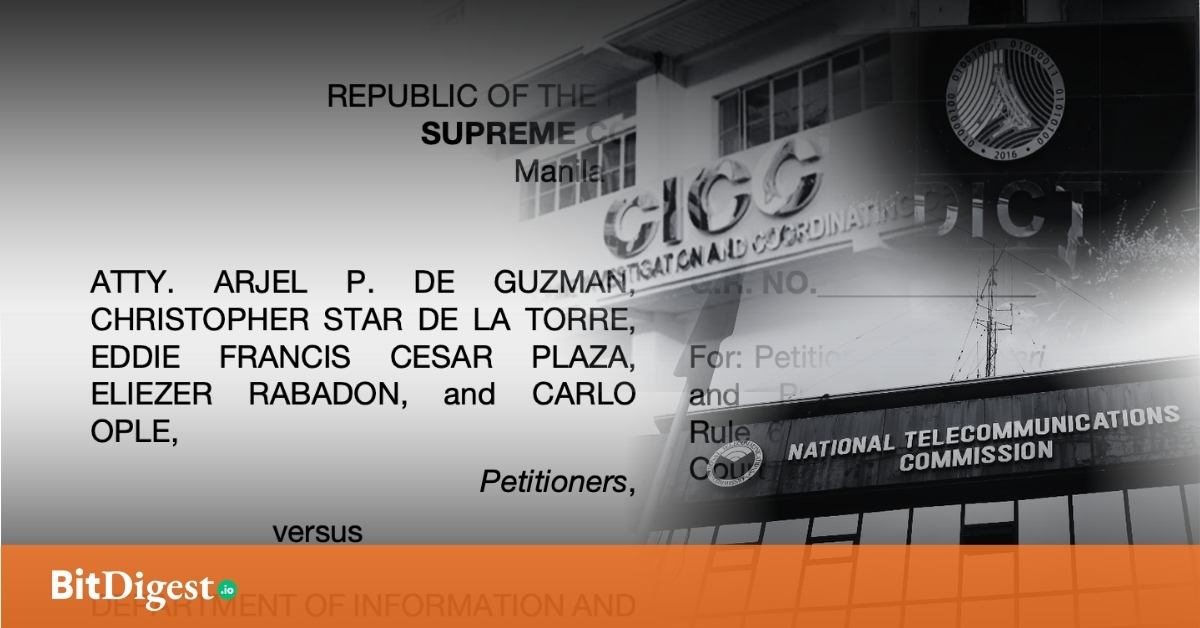
A group of technology advocates has asked the Supreme Court to determine whether the Philippine government has the legal authority to order the nationwide blocking of an entire online platform without specific statutory authority or prior judicial intervention, following the temporary suspension of Discord access in September.
The petition, filed under Rule 65 by Atty. Arjel P. de Guzman, Christopher Star De La Torre, Eddie Francis Cesar Plaza, Eliezer Rabadon and Carlo Ople, challenges directives issued by the Cybercrime Investigation and Coordinating Center (CICC) and the National Telecommunications Commission (NTC), with Department of Information and Communications Technology (DICT) Secretary Henry Rhoel Aguda also named as a respondent.
The petition seeks to annul the blocking orders and permanently prohibit the respondents from imposing unilateral, wholesale, nationwide blocks or geofencing of online platforms.
At the center of the case is a question that extends beyond Discord: When the government wants an entire online platform taken offline, who has the legal authority to flip the switch?
How the Discord “Switch” Was Pulled
The sequence of events is central to the petition.
On September 21, the CICC sent letters to Discord and Reddit requiring them to designate a resident agent or establish a local representative in the Philippines within 24 hours.
The government cited the need for faster coordination with platforms on issues involving child safety, online sexual abuse and exploitation of children (OSAEC), grooming, scams, nihilistic violent extremism and other cyber threats.
The following day, the CICC issued Directive No. NTC-CICC-2026-09-001 requesting the NTC to implement a 15-day precautionary suspension and geofencing of Discord.
On September 23, the NTC issued a memorandum directing Philippine internet service providers to block access to Discord.
Major networks subsequently restricted access to the platform that evening.
The measure did not last the proposed 15 days. After a meeting between government officials and Discord representatives on September 24, the block was lifted. Discord committed to cooperation measures that included establishing a local point of contact, creating a direct coordination channel or “green lane,” and strengthening safety measures.
The government therefore restored access before the dispute could proceed through a full judicial review.
For the petitioners, however, that did not end the issue.
Where Does the Government’s Blocking Power Come From?
The petition’s central argument is that none of the laws governing the three agencies expressly grants them the power to order the wholesale blocking of an online platform.
The petitioners point to the NTC’s authority under Republic Act No. 7925, the Public Telecommunications Policy Act; DICT’s mandate under Republic Act No. 10844; and the Cybercrime Prevention Act of 2012, or Republic Act No. 10175.
Their position is that these laws do not delegate to DICT, CICC or NTC the specific authority to impose nationwide geofencing or otherwise make an entire communication platform inaccessible.
The petition therefore characterizes the directives as ultra vires — actions allegedly taken beyond the agencies’ delegated powers.
That argument puts the legal source of the blocking authority ahead of the government’s stated reason for using it.
The issue is not simply whether authorities had legitimate concerns about Discord. It is whether those concerns gave executive agencies the legal power to impose the particular remedy they chose.
Why Disini Is Central to the Challenge
The petitioners rely heavily on the Supreme Court’s 2014 decision in Disini v. Secretary of Justice.
In that case, the Court struck down Section 19 of the Cybercrime Prevention Act, which allowed the Department of Justice to restrict or block access to computer data allegedly constituting a cybercrime.
The petitioners invoke that ruling in challenging the Discord directive, arguing that the government cannot bypass judicial safeguards by using administrative action to restrict access to online material.
Their argument is not that Disini already ruled on the Discord incident. Rather, they are asking the Supreme Court to apply its constitutional principles to a different form of government action: the nationwide blocking of an entire platform.
That distinction matters because the legality of the September Discord block itself remains unresolved.
Blocking a Platform Is Not the Same as Blocking Content
The petition also draws a line between targeted enforcement and platform-wide restriction.
An enforcement action can be directed at a particular account, URL, file or piece of unlawful material.
The Discord order, by contrast, affected access to the platform as a whole.
That meant the restriction potentially reached lawful and unlawful activity at the same time.
For the petitioners, that makes the measure an especially broad restraint on speech and expression.
They argue that Discord functions not only as a gaming communication service but also as a venue for education, business, professional communities and other forms of communication. A platform-wide restriction therefore affects users who have no connection to the conduct that prompted the government’s intervention.
The petition characterizes the measure as an unconstitutional prior restraint and argues that it should be subjected to the constitutional safeguards applicable when government action affects protected expression.
The Government’s Case Is About Child Safety and Cybercrime
The government’s rationale is different.
The CICC framed the intervention around the need for platforms to maintain a local presence capable of responding quickly to lawful government requests and addressing online threats.
Officials cited concerns involving child exploitation, grooming, scams, violent extremist material and other cybercrime-related risks. The government also invoked the State’s parens patriae role in protecting minors.
The September action was presented as precautionary and temporary rather than a permanent prohibition against Discord.
That distinction is important.
The government ultimately lifted the restriction after meeting with Discord and obtaining commitments on cooperation and safety measures.
The dispute before the Supreme Court therefore does not concern a platform that remains blocked. It concerns whether the government had the authority to impose the block in the first place and whether it can use a similar mechanism again.
The Petition Says the Method Matters
The petitioners do not frame their challenge as an argument that the government should be unable to pursue online child protection or cybercrime enforcement.
Their objection is directed at the method and legal authority used to pursue those objectives.
They argue that the government could have pursued narrower measures, including action against specific unlawful content or accounts, rather than restricting access to an entire platform.
The petition also raises due process concerns, arguing that Discord was given only 24 hours to comply with the government’s demand before the subsequent blocking process began.
According to the petition, there was no meaningful administrative hearing, disclosure of evidence or opportunity to contest the necessity, scope and duration of the restriction before the platform-wide measure was implemented.
The petition further argues that the restriction violated equal protection by singling out Discord without establishing a legally sufficient distinction between it and other platforms that could potentially present similar risks.
It also raises overbreadth and vagueness concerns, arguing that the government did not establish clear standards for when an entire platform could be blocked, what evidentiary threshold would trigger such action, or what procedure would govern its lifting.
An Admission About Discord’s Uses Has Also Become Part of the Case
The government’s own response after the block provides another element of the petitioners’ argument.
CICC officials acknowledged that they had not fully appreciated how Discord was being used in the Philippines beyond gaming, including for business and education.
The admission was accompanied by an apology to users affected by the disruption.
The petitioners point to that episode as evidence that authorities may not have sufficiently assessed the platform’s broader lawful uses before resorting to a nationwide block.
That does not, by itself, establish that the blocking order was unconstitutional. But it forms part of the petitioners’ broader argument that less restrictive alternatives and the consequences for lawful users were not adequately considered.
Why the Case Did Not End When Discord Came Back
One of the petition’s more consequential arguments concerns mootness.
Because Discord access was restored within roughly a day, there is no longer an active platform-wide restriction for the Supreme Court to order lifted.
The petitioners nevertheless argue that the case remains reviewable because it falls within recognized exceptions to the mootness doctrine.
Most notably, they characterize the situation as capable of repetition yet evading review.
Their concern is a potential cycle in which an agency issues a blocking directive, the platform quickly complies, access is restored, and the underlying legality of the government’s action never receives judicial review before the controversy disappears.
That is why the petition seeks prospective relief rather than merely asking the Court to restore Discord.
The petition asks the Supreme Court to permanently prohibit the respondents from imposing unilateral, wholesale, nationwide blocking or geofencing of websites and social-networking platforms.
The Bigger Question Is Who Gets to Flip the Switch
The Discord dispute therefore leaves two separate questions on the table.
The first is whether government agencies have a legitimate interest in protecting children, addressing cybercrime and requiring global platforms to maintain effective channels for lawful coordination.
The government says they do.
The second is whether those interests give DICT, CICC and NTC the authority to make an entire online platform inaccessible nationwide, and what legal and constitutional safeguards must apply before they can do so.
That is the question the petition puts before the Supreme Court.
The case also comes as online platforms have become part of ordinary economic and social infrastructure, used not only for entertainment but for education, work, professional communities and digital commerce. A platform-wide restriction can therefore affect people and activities far removed from the conduct that initially triggered government intervention.
For now, however, the Supreme Court has not ruled on the petition. As of early October 2026, the petition had been filed, but no G.R. number or substantive Supreme Court action had been publicly reported.
Discord is back online. Whether the government can take it down again, and on whose authority, remains unanswered.
.svg) SHARE TO FACEBOOK
SHARE TO FACEBOOK SHARE TO TWITTER/X
 SHARE TO LINKEDIN
 SEND TO MAIL


.svg)


.svg)