Inclusive Innovation: Pioneering Women in Web3 Ecosystems

Women have played a crucial role in shaping today's society through their valuable contributions. Their impact extends far beyond their appearances, as they have continuously proven their worth in various fields. In light of this, many women have demonstrated their capabilities not just in the traditional field but also in the emerging Web3 landscape as well.
Despite some progress in achieving equality, women still confront persistent disparities ‚ including gender wage gaps, harassment, and discrimination in opportunities. In fact, based on a study by the World Bank Group back in 2022, participation of women in the Philippine workforce remains consistently low. In 2019, only 49% of women in the Philippines were part of the labor force, one of the lowest rates in the East Asia and Pacific region (where the average is 59%). In contrast, a significant 76% of Filipino men were engaged in the workforce, highlighting a substantial gender gap.
As a new realm, Web3 hopes to be a game-changer, offering women new opportunities to assert their presence and influence. However, even in this emerging industry, obstacles remain.
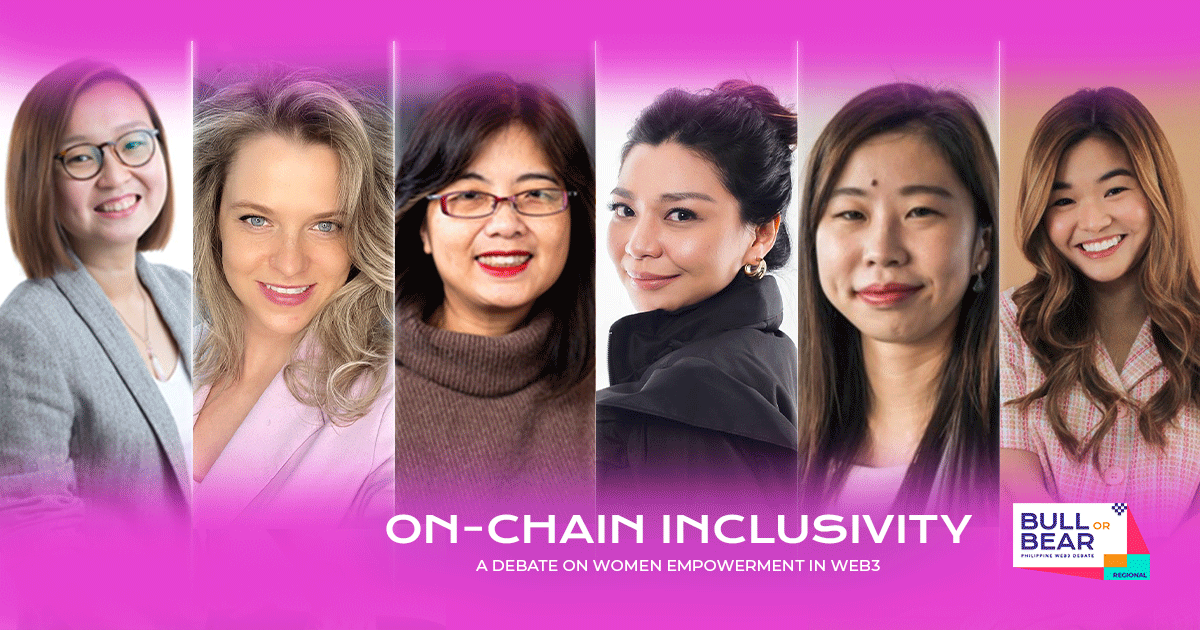
Edutech company Bitskwela hoped to explore these issues in the latest rendition of their Bull or Bear debate series. On-Chain Inclusivity was a debate focusing on women's empowerment in Web3. The event invited key women opinion leaders from the crypto community to discuss whether or not Web3 was a progressive place for women.

The debaters invited were Modern Mulan, an entrepreneur and Web3 advocate; Ivy Gutierrez, chairperson of GMMG Lady Traders; Belinda Lim, the Singapore Representative for Women in Blockchain Asia and an accomplished author in blockchain technology; Ida Mok, the President of Women in Blockchain ASIA; Nataliya Ilyushina, Economist and Research Fellow at the Blockchain Innovation Hub at RMIT University; and Irene Umar, the CEO of W3GG, the official guild partner of Yield Guild Games in Southeast Asia. Kish Morales, Community Manager for Cryptopolis and Magic Shiba Starter and formerly a Department Director of Blockchain Network Philippines, moderated the debate.
The first prompt tackled in this debate was "Anonymity in Web3 leads to more online harassment."
Irene was bullish with this statement, saying that anonymity gives users an invisible cloak to do whatever they want, and it removes their responsibility. Mulan backed this statement, saying that there were a lot of ethical and legal considerations to consider since it could embolden people to commit crimes.
On the other hand, Ivy was bearish, saying this phenomenon was not exclusive to Web3 since cyberbullying was very present in Web2. Nataliya also gave an exciting situation wherein anonymity in Web3 helped a woman experiencing discrimination due to her skin color. Upon using an anonymous persona, she realized that she was being treated better.
The audience was asked for their opinion which showed 52% siding bullish and 48% siding bearish.
Next, the debate explored whether the lack of regulation in Web3 exposes women to higher risk in the space.
For this prompt, Nataliya was bullish, noting how regulation is set in place to protect us. She stated that in developing countries with lower access to skills and education, a lack of regulation would hurt women. Moreover, she specified that decentralized organizations do not provide benefits for women, such as social welfare benefits and maternity leaves. Ivy also backed the need for regulation by pointing to the problems of many Web3 businesses in America due to their conflict with the Securities and Exchange Commission (SEC).
Belinda was bearish on this, citing that regulations mainly protect those in the mainstream industry and are primarily discriminatory towards women. She brought up an example wherein, during the peak of the COVID-19 pandemic, a lack of regulation actually gave women more jobs. Ida also emphasized that it was important for regulators to have women's best interests at heart, and if most were men, nothing much would change.
For this topic, the audience votes were split 50/50 between bullish and bearish.
Moving forward to prompt 3 of the debate, the topic discusses Privacy in Web3 and whether it now aligns with women's rights and empowerment. Ivy stands bullish on the statement, while Irene is bearish.
Ivy pointed out her stance by narrating a scenario in their trading community wherein some members hide behind avatars and unique names. This helps their community reduce gender biases and barriers as privacy and anonymity level the playing field.
Irene stands bearish in this statement as she leaves a powerful statement, "Why do we need to hide behind the veil of anonymity to act like who we are?"
"Whether you are male or female, we all should be able to set our own feet and say that no matter who I am, judge me based on what I have to deliver, what I have to do, give to the world, (and) what I have to contribute to the world," Irene added.
The audience then contributed to the topic through voting, with 58% on the bearish side and 42% on the bullish side.
In the middle of the debate, an interesting topic was brought up, stating whether the debaters agree or disagree that "Women empowerment should be one of the top priorities in Web3." Mulan stands on Bullish, while Nataliya is on Bearish.
For Mulan, we should focus on what's lacking on Web2‚ decentralization, privacy, security, and scalability. She also included diversity and inclusivity, which covers women empowerment and gender disparity. However, for Nataliya, there are way more underrepresented groups in Web3 than women. She emphasized other issues, like how Web3 is reliant on the internet, and only 60% of the world has access to it.
The topic received input from the audience, with 60% expressing a bearish sentiment and 40% leaning toward a bullish perspective.
Heading towards the tail-end of the debate, the question of the hour was dropped, asking if "Women-led initiatives are harder to foster in web3".
Ida confidently agreed with this by claiming that numbers and statistics proved it. To her, Web3 is still transitioning from Web2, which is very much male-dominant. Even terms like "crypto bros" show the current state of the Web3 space, Ida exclaimed. Nataliya also viewed the average person as more "traditional" than a Westerner, making it more difficult for women to lead. Belinda was also bullish and clamored for proper leaders and leadership to support women in Web3.
Inspired by the successful women in the Web3 space, Ivy strongly disagreed with this prompt by citing examples of women who have changed the Web3 space, like Elizabeth Stark, founder of Lighting Labs, and Catherine Wood, CEO of Ark Invest. Irene added that it was not necessarily harder for women in Web3 than Web2 and that Web2 was much more "political."
The bullish side came on top for the audience with 56% feeling bullish while 44% were bearish.
To end the night, the last prompt gave the simple statement, "Web3 is currently not conducive to women's involvement in the space".
Belinda wholeheartedly agreed by showing how most people viewed blockchain as a futuristic dream. Due to this, there needs to be more work, funding, and execution on the present problems, such as empowering women in web3. She called for all of us to acknowledge the problems and do work to change them.
Countering this notion, Mulan defended the bearish stance by highlighting the very women in the debate as solid indicators that web3 is encouraging, productive, and supportive of women speaking out. She also pointed to various supportive entities, such as Bitskwela, which provide women a platform in the blockchain industry.
Surprisingly, every other debater was also bearish with this claim. Irene claimed that no other place would have all women on a stage. Irene praised Web3 for being inclusive and having a low entry cost. Ida was hopeful that women having many male allies in Web3 would lead to opportunities. Lastly, Ivy loved that women sharing their expertise in Web3 leads more women to get involved.
The debate ended with a positive message from the moderator, Kish, who said, "Whatever the industry, there will always be challenges, but it does not mean women are not ready for Web3. Women are here and willing to do so much more."
The bearish side had an astounding win here, with the audience voting 77% bearish and 23% bullish.
Opportunities for Women in Web3
While these pressing challenges remain prevalent, we can still look at the bright side of Web3, wherein more opportunities are being presented to women.
In a traditionally male-dominated sector, Web3 provides a more level playing field and an opportunity for women to engage and flourish actively. Through community groups, women in Web3 are now actively taking leadership roles and initiating the direction of several initiatives. This emerging space has also opened a new avenue for female entrepreneurs to prove their capabilities and launch their own innovative projects.
Most importantly, this new realm allowed women from different nations to participate in advanced technological fields, breaking down traditional barriers.
By encouraging women to speak up and giving them a platform to make changes, we move closer to a more inclusive community, a more inclusive Web3. Debates like this are only a start, and we definitely can do much more. Whether we are bullish or bearish on the various prompts given, what is for sure is that we all want a safer and more progressive space. Let's work together to make Web3 a better community for women and all people alike!
For more information about the event, watch the Bull or Bear: "On-Chain Inclusivity" debate here:
 SHARE TO FACEBOOK
 SHARE TO TWITTER/X
 SHARE TO LINKEDIN
 SEND TO MAIL