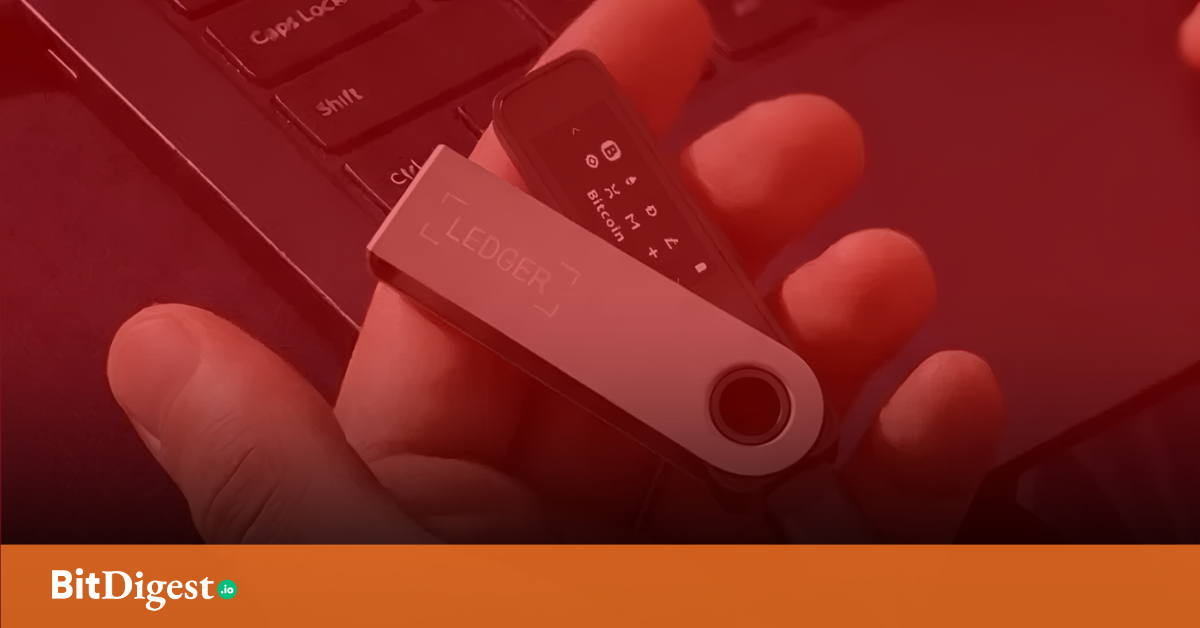
Ledger Supply-Chain Attack Exposes Blind Spot in Hardware Wallet Security

Unauthorized hardware implants in Ledger devices sold through Southeast Asian reseller CryptoBilis allowed attackers to capture wallet recovery phrases without compromising the devices’ cryptographic Secure Element, exposing a critical weakness in the distribution chain.
Ledger’s confirmation of unauthorized hardware implants in genuine hardware wallets has exposed a security gap that extends beyond the cryptographic protections built into the devices: the assumption that a wallet remains trustworthy after leaving the manufacturer.
In October 2026, the French hardware-wallet maker confirmed that at least one device linked to cryptocurrency thefts involving its Southeast Asian reseller, CryptoBilis, contained an unauthorized hardware implant. Ledger said its own manufacturing systems, security infrastructure and services had not been compromised, describing the incident as a distribution-channel attack rather than a breach of its production environment.

Independent blockchain analysts have estimated the resulting losses at between $86 million and $102 million across hundreds of wallets. Ledger has not confirmed a definitive loss total, and the number of affected devices remains limited according to the company’s public statements.
The incident highlights a distinction central to hardware-wallet security: protecting cryptographic operations does not necessarily protect a device that has been physically modified after manufacture.
How the Hardware Implant Captured Recovery Phrases
According to technical findings published by Ledger Donjon, the company’s security research team, the attackers installed additional electronic components inside genuine Ledger devices. Independent researchers have documented implants involving a microcontroller, a cellular communications module and an embedded SIM, or eSIM.
The modifications reportedly allowed the implant to monitor data sent to the device’s display during initial setup. When a user generated a new wallet, the Ledger displayed its 24-word recovery phrase on the screen. The implant could capture the information and transmit it over a cellular connection.
Because the implant used its own communications hardware, it did not need access to the user’s computer, phone or Wi-Fi network to transmit the captured phrase.
Once attackers obtained a recovery phrase, they could restore the wallet elsewhere and gain control of its assets. Blockchain investigators subsequently identified coordinated transfers from hundreds of affected wallets.
The attack did not require the attackers to alter the wallet’s transaction-signing process or defeat its Secure Element, the specialized chip designed to protect sensitive cryptographic operations.
That distinction matters. The Secure Element can perform its intended cryptographic functions while a separate, unauthorized component captures sensitive information displayed elsewhere on the device.
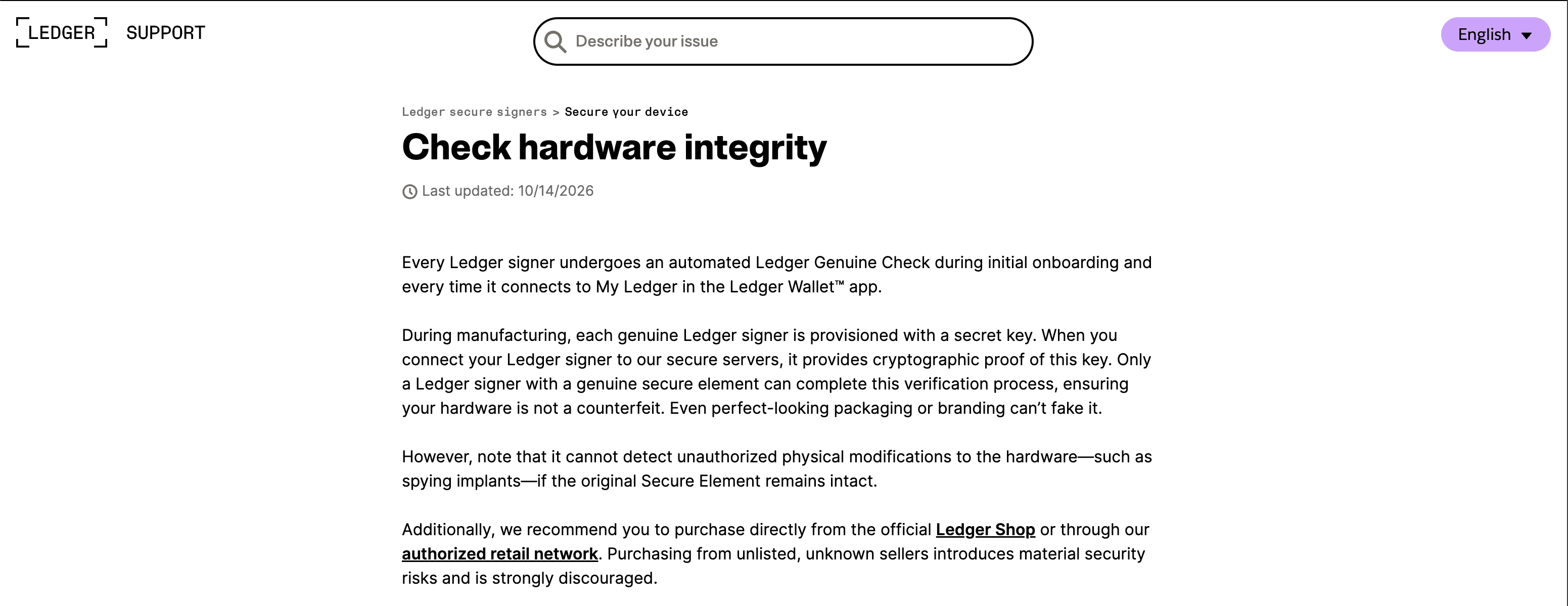
Ledger’s Genuine Check also did not necessarily expose the modifications. The verification mechanism authenticates the device’s Secure Element; it is not designed to guarantee that every physical component surrounding the chip remains unmodified.
Consequently, a device could retain genuine cryptographic hardware and pass its authenticity check while containing an implant that compromises the recovery phrase during setup.
The Distribution Chain Became the Point of Compromise
Ledger’s investigation linked the confirmed October incident to devices sold through CryptoBilis, an authorized reseller serving Malaysia, Indonesia and the Philippines.
The devices were reportedly genuine products that had been acquired, physically modified and reintroduced into the regional distribution chain. This differs from an attack involving counterfeit wallets or a direct compromise of Ledger’s manufacturing systems.
The distinction also explains why factory authenticity and physical integrity are not interchangeable. A device may have originated from the legitimate manufacturer without reaching its eventual customer in the same condition.
Ledger described the operation as a highly organized criminal effort involving the acquisition and modification of genuine devices over several months. The company subsequently tightened its reseller requirements, including restrictions on reselling returned devices and requirements for handling inventory and reporting anomalies.
The incident has also prompted precautionary responses elsewhere in the distribution network. MediaMarktSaturn suspended Ledger sales in Europe following a separate customer report of a possible implant in Germany. Ledger had not confirmed associated fund losses in that case as of October 20.
Trezor and OneKey have also reportedly ended their relationships with CryptoBilis.
These actions reflect concerns about distribution-channel integrity, although the separate reports should not be treated as proof that the same attack affected devices sold outside the confirmed CryptoBilis channel.
What the Incident Means for Self-Custody
Hardware wallets are designed to give users greater control over their digital assets by keeping private keys protected within a dedicated device rather than exposing them to a general-purpose computer or smartphone.
The CryptoBilis incident did not demonstrate that this cryptographic model had been defeated. Instead, it exposed a different failure point: the recovery phrase could be captured before the wallet’s cryptographic protections became the deciding factor in asset security.
A recovery phrase represents the underlying secret needed to reconstruct a wallet. If an attacker obtains it, the attacker may be able to access the associated assets without possessing the original hardware device.
This makes the circumstances surrounding recovery-phrase generation particularly important. In the reported attack, the implant targeted the setup process, when the phrase was displayed in plaintext for the user to record.
The broader implication is that hardware-wallet security cannot be assessed solely by examining the Secure Element, firmware or transaction-signing architecture. Physical integrity, inventory handling, reseller oversight and the process through which devices reach customers also affect the security of self-custody.
That does not mean hardware wallets are inherently unsafe or that self-custody has become unworkable. It means that the security of a device depends on more than its cryptographic design.
Why Institutional Custodians May Need Additional Safeguards
For institutional investors, family offices, exchanges and fintech companies, the incident raises questions about whether a single hardware device and a single recovery secret provide sufficient protection for the value being held.
One possible additional safeguard is a multi-party computation (MPC) arrangement, in which multiple parties participate in cryptographic signing without necessarily reconstructing a single private key in one location. Another is a threshold-signature scheme that requires a defined number of key shares or participants to authorize a transaction.
These approaches can reduce reliance on a single signing device or secret, depending on their implementation. They do not, however, eliminate every supply-chain risk. The security of an MPC or threshold-signature system still depends on its software, key-generation process, participants, operational controls and implementation.
Institutions may also consider stronger hardware-provenance controls, including documented custody from procurement through deployment, tamper inspections, restricted inventory access and procedures for verifying devices before they are used to secure significant assets.
For hardware-wallet manufacturers, the incident highlights the need to examine whether authenticity checks and reseller controls adequately address physical modifications that leave the original cryptographic components intact.
For regulators and industry standards bodies, the case raises a broader question about how supply-chain assurance should be incorporated into digital-asset custody requirements. The incident alone does not establish that any particular regulatory mandate or custody architecture is necessary for every institution, but it provides a concrete reason to examine the issue.
Losses and Responsibility Remain Under Investigation
Independent on-chain estimates place the losses associated with the CryptoBilis incident between approximately $86 million and $102 million. The estimates vary, and Ledger has not published a definitive total.
Some assets have reportedly been frozen, including approximately $10 million in USDT by Tether, alongside limited action involving USDC. Other funds are believed to have moved through laundering routes involving privacy-enhancing services or assets that can be more difficult to trace or freeze.
These figures and assessments remain dependent on independent blockchain analysis and reports from the companies involved. The full amount recovered, the final number of victims and the proportion of losses that remain unrecoverable have not been conclusively established.
Questions also remain about when the devices were modified, where the work took place and who was responsible for introducing them into the distribution chain.
CryptoBilis underwent an ownership transition in 2026, and its former co-founders said they had relinquished operational control. However, no definitive public evidence has established a connection between that transition and the hardware tampering.
The confirmed implant findings establish that physical modifications compromised at least some devices. They do not, on their own, identify every person involved or establish that the ownership change facilitated the attack.
Ledger has said it is cooperating with authorities, contacting potentially affected users and developing additional anti-tampering measures. The company has also advised affected customers to follow its official guidance and avoid sharing recovery phrases with anyone claiming to represent Ledger.
 SHARE TO FACEBOOK
 SHARE TO TWITTER/X
 SHARE TO LINKEDIN
 SEND TO MAIL