.svg)

.svg)
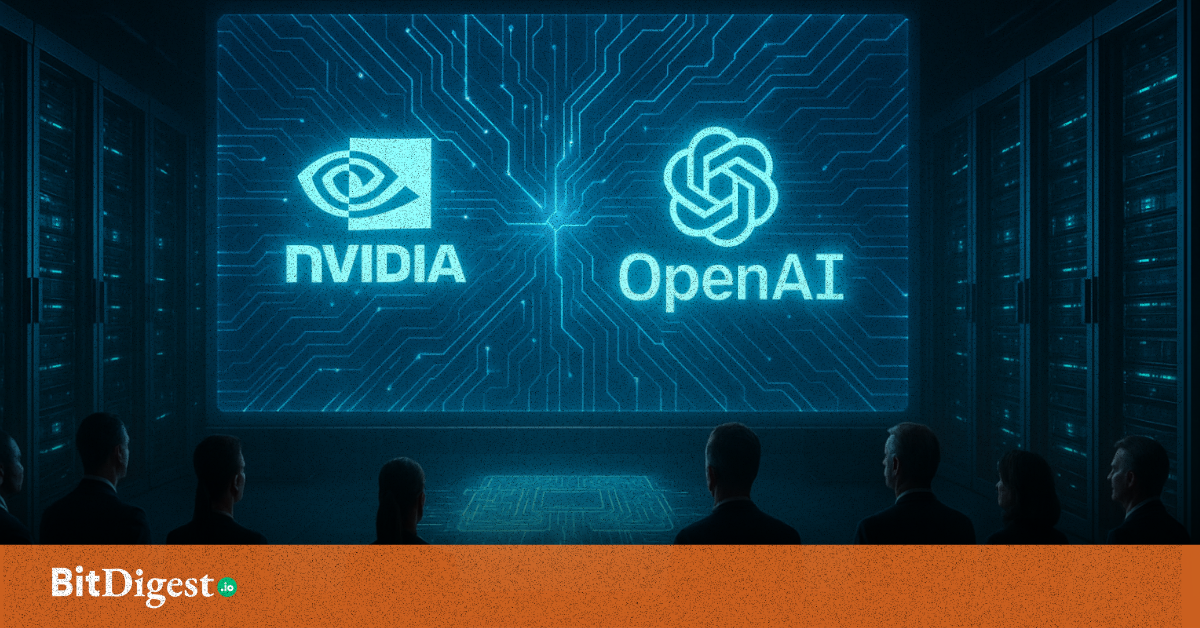
Nvidia–OpenAI $100B Mega-Investment Off the Table as Talks Shift, Partnership Remains Intact

Talks between chipmaker Nvidia and AI developer OpenAI are being reshaped into a smaller, more flexible partnership after an earlier proposal for a vast infrastructure build-out failed to move forward in its original form.
In September 2025, the two companies signed a non-binding letter of intent outlining a plan to deploy at least 10 gigawatts of AI computing capacity beginning in late 2026. Media reports at the time described potential investments of up to $100 billion over multiple years, tied to data centers and large GPU clusters rather than a single upfront payment.
That headline figure is no longer expected to materialize as a single mega-commitment.
According to reporting in January 2026, discussions have shifted toward smaller, modular arrangements. These could include Nvidia taking an equity stake in OpenAI’s ongoing fundraising round, with the amount described by reports as potentially in the “tens of billions” rather than $100 billion.
On January 31, Nvidia chief executive Jensen Huang publicly confirmed that his company will “absolutely” participate in OpenAI’s raise with what he called a “huge” investment, likely Nvidia’s largest ever in another company. At the same time, he made clear that the previously reported $100 billion scale was not the plan going forward.
Huang also rejected suggestions of a falling-out, praising OpenAI and its chief executive Sam Altman and emphasizing that Nvidia will continue supplying hardware both to OpenAI and to rival AI developers.
There has been no on-the-record statement that Nvidia has cancelled all investment plans, nor any indication that their commercial relationship is ending. Instead, the change reflects a move away from an unprecedented, highly concentrated bet toward staged funding and project-by-project collaboration.
Industry context helps explain the rethink. A single $100 billion commitment to one partner would have created concentration and regulatory risks for Nvidia and reduced flexibility in a fast-moving AI market where competitors and architectures are evolving quickly. More incremental funding allows both sides to adjust to demand, technology shifts and competition.
OpenAI, for its part, is pursuing a broad funding round involving multiple large investors, with press reports naming companies such as Microsoft and Amazon among potential participants. That diversified approach reduces reliance on any one backer while supporting the heavy capital needs of advanced AI model training and deployment.
The practical outcome is that collaboration is expected to deepen operationally rather than through a single headline cheque. Nvidia is likely to continue supplying large volumes of GPUs and related systems to OpenAI, while also investing directly in the company at a lower, staged level.
For the broader AI industry, the shift signals maturation. Instead of one outsized, hype-driven mega-deal, funding and infrastructure are more likely to be built through multiple, scalable investments tied to real demand.
In plain terms: the once-talked-about $100 billion all-in deal is off the table, but the partnership is not. Nvidia is set to make a very large, though smaller, investment in OpenAI while continuing to power its systems with Nvidia hardware as both companies pursue growth alongside other partners.
.svg) SHARE TO FACEBOOK
SHARE TO FACEBOOK SHARE TO TWITTER/X
 SHARE TO LINKEDIN
 SEND TO MAIL




.svg)


.svg)