.svg)

.svg)
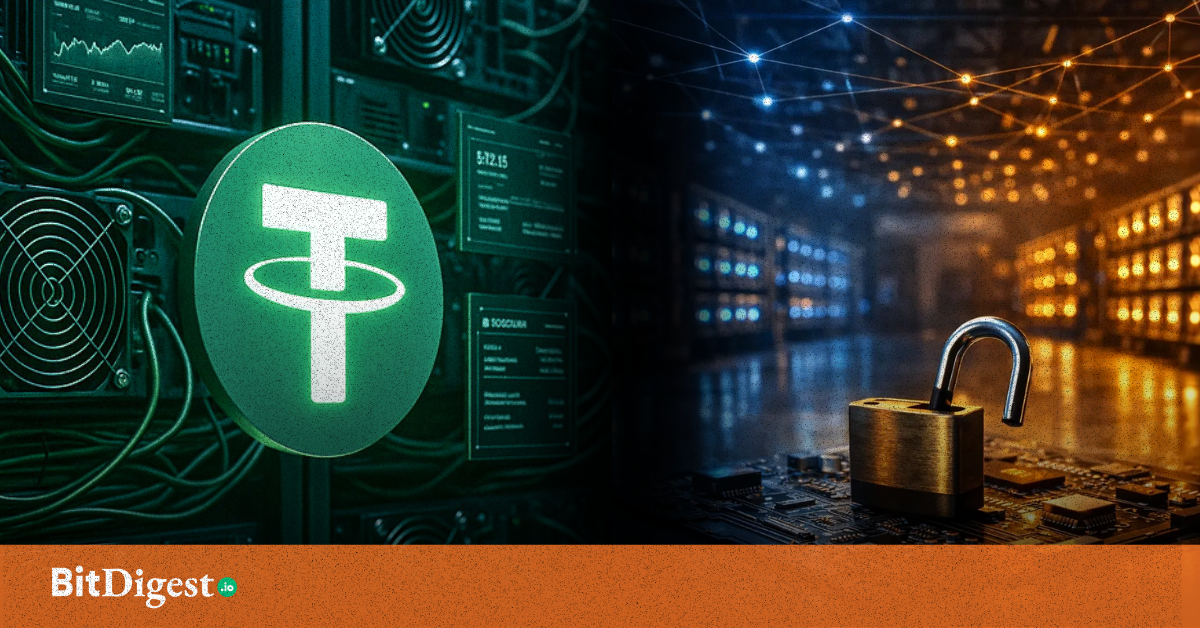
Tether Moves Beyond Stablecoins With Open-Source Bitcoin Mining Software

Tether, the company behind the world’s largest stablecoin, has taken a new step into Bitcoin infrastructure by releasing an open-source operating system designed to run and manage mining operations of all sizes.
The software, called MiningOS (MOS), was announced this week and made freely available to the public. It is designed to help Bitcoin miners monitor machines, manage energy use, and coordinate operations from a single system—without relying on proprietary, paid platforms.
What MiningOS does, in simple terms
Bitcoin mining requires specialized computers that consume large amounts of electricity and need constant monitoring. Today, many miners rely on a patchwork of paid software tools to track performance, manage cooling, and detect hardware failures.
MiningOS aims to simplify that process.
Think of it as a Linux-style operating system for mining rigs: one platform that lets miners see how their machines are running, how much power they’re using, and whether something needs fixing—all in one place.
Because it is open-source, anyone can inspect the code, modify it, or adapt it for their own setup. Tether released the software under the Apache 2.0 license, meaning it can be used freely by individuals, companies, or even competitors.
Why this matters for the mining industry
One of the biggest advantages of MiningOS is cost and control. Many existing mining management systems are proprietary and subscription-based, which can be expensive for smaller operators and lock users into a single vendor.
Tether says MiningOS is designed to:
- run locally, rather than through centralized cloud servers
- communicate through peer-to-peer connections
- scale from home mining setups to large industrial facilities
That approach could make it easier for smaller miners to operate independently, rather than relying on software controlled by a handful of large providers.
A broader signal from Tether
While Tether is best known for issuing USDT, the dollar-pegged stablecoin, the company has been expanding steadily into Bitcoin-related infrastructure. In recent years, it has invested in mining operations and energy-linked projects, positioning itself not just as a financial issuer but as an ecosystem builder.
MiningOS fits into that strategy. Instead of launching another financial product, Tether is offering tools that support the underlying systems that keep Bitcoin running.
What this does—and does not—change
MiningOS does not alter Bitcoin’s rules, economics, or consensus system. It does not make mining automatically profitable, nor does it reduce the need for expensive hardware or cheap electricity.
What it does offer is greater transparency and flexibility in how mining operations are managed—especially for operators who want to avoid closed, black-box software.
The bigger picture
As Bitcoin mining becomes more professionalized and capital-intensive, software has quietly become a point of centralization. By open-sourcing MiningOS, Tether is betting that lower barriers and shared infrastructure can help keep mining more distributed.
Whether miners adopt it at scale remains to be seen. But the launch signals a clear message: Tether wants a role not only in how crypto is traded, but also in how its core infrastructure is built and run.
.svg) SHARE TO FACEBOOK
SHARE TO FACEBOOK SHARE TO TWITTER/X
 SHARE TO LINKEDIN
 SEND TO MAIL


.svg)


.svg)