.svg)

.svg)
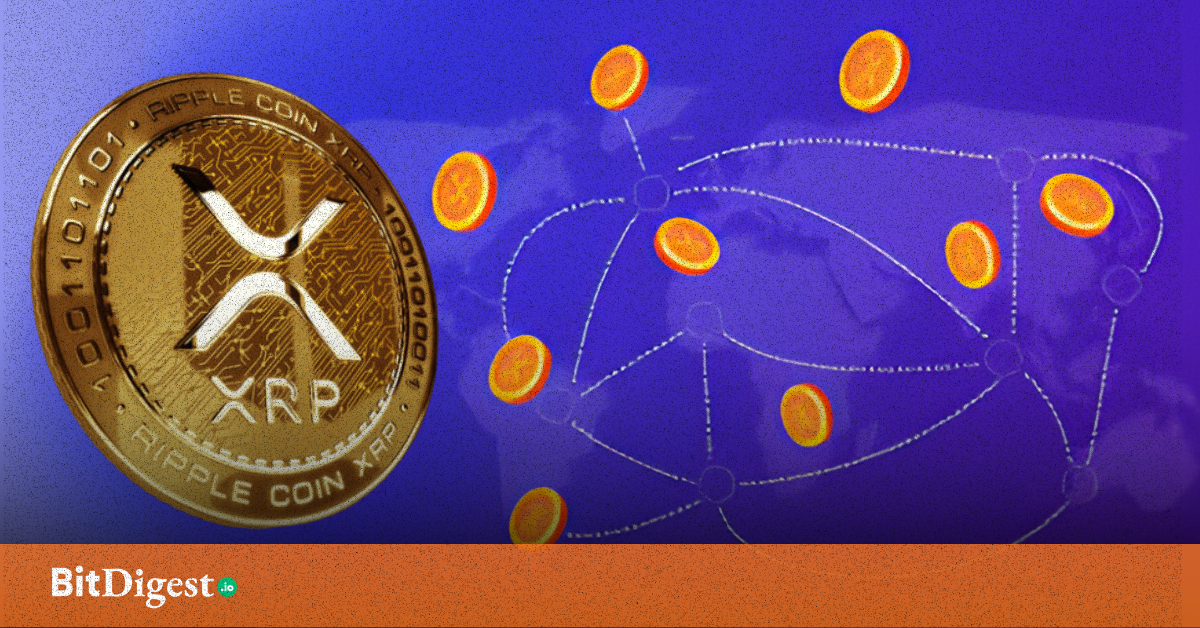
XRP and the Infrastructure Shift in Cross-Border Payments

XRP, the native asset of the XRP Ledger (XRPL), has re-entered the cross-border payments conversation, not as a speculative instrument, but as a settlement component inside regulated financial workflows. The distinction matters because blockchain’s role in payments is not defined by market cycles but by infrastructure adoption, particularly in corridors where traditional banking rails remain slow, fragmented or capital-intensive.
XRPL finalizes transactions in roughly three to five seconds, providing deterministic settlement and around-the-clock availability. This stands in contrast to correspondent banking systems, which rely on multiple intermediaries, operate within banking hours, and can introduce settlement delays through cutoff times and reconciliation cycles. Even where recent upgrades like SWIFT GPI have accelerated messaging and tracking, cross-border settlement still generally conforms to bank-based schedules, daylight clearing windows and prefunding requirements.
Ripple’s On-Demand Liquidity (ODL) model, which uses XRP as a bridge asset between currencies, is designed to shorten the settlement component of international transfers and reduce the need for foreign prefunded accounts. This approach does not eliminate compliance screening, domestic clearing, FX pricing windows or volatility management, but it does compress one of the slowest legs of cross-border value movement: inter-institution settlement across currencies and time zones.
Notably, the infrastructure is no longer theoretical. Several deployment cases demonstrate how blockchain-based settlement can improve liquidity efficiency or capital allocation in specific corridors and business models.
In Asia, SBI Remit launched Japan’s first crypto-asset remittance service in 2021, using XRP settlement for payouts in the Philippines. The initiative later expanded to Indonesia and Vietnam. The rationale extends beyond nominal speed; Japan and Southeast Asian economies operate on different banking schedules, and traditional remittance routes often rely on a chain of correspondent banks. XRP-based settlement reduces the dependency on overlapping banking hours and allows providers to lower prefunding requirements in destination markets.
In Southeast Asia, Malaysian fintech Tranglo rolled out ODL support across more than twenty-five corridors, linking markets such as Malaysia, Singapore, Thailand, Vietnam and the Philippines. Multi-corridor networks tend to magnify operational friction due to inconsistent domestic clearing systems and FX rails. A standardized settlement layer can reduce this variability and help payment companies rebalance liquidity more predictably.
In Europe, Paris-based Lemonway integrated Ripple for cross-border treasury flows. Unlike retail remittances, this use case is institutional: marketplace operators must disburse funds across jurisdictions without immobilizing capital in foreign accounts. By freeing capital from prefunding structures, payment companies can allocate more liquidity to operations and expansion rather than idle accounts.
In Africa, Onafriq (formerly MFS Africa) partnered with Ripple to route payments between Africa and regions including the Gulf Cooperation Council, the United Kingdom and Australia. Africa’s payment corridors face structural limitations—fewer correspondent links, diverse payout mechanisms across 27 countries, and reliance on both mobile money and cash-based agents. For such corridors, blockchain-based settlement offers operational advantages that are less visible in highly banked regions such as North America or Western Europe.
Ripple also appears to be expanding into institutional post-trade workflows. The company agreed to acquire prime broker Hidden Road for $1.25 billion in 2025. Reuters reported that Hidden Road clears nearly $3 trillion annually across hundreds of institutional clients. Ripple has indicated that portions of post-trade settlement operations could migrate to XRPL over time, potentially applying blockchain to collateral movement and reconciliation—critical but often overlooked components of financial plumbing.
Separate from institutional credit and settlement, Ripple’s acquisition of Rail in 2025, along with the launch of an XRPL-native stablecoin (RLUSD), suggests it may support both bridge-asset settlement via XRP and stablecoin-based corporate payments, depending on client preference and regulatory conditions. These models are not mutually exclusive; both target structural delays in the movement of money across borders.
The value proposition is not simply “speed,” nor is it the reduction of fees in consumer remittances. The strategic outcome is capital efficiency—how much liquidity a payments business must trap in foreign jurisdictions to guarantee timely payouts, and how fast it can move funds between markets as transaction volumes shift. In that sense, XRP functions less as a currency bet and more as a settlement primitive.
Challenges remain. Regulatory compliance, liquidity sourcing, FX execution and domestic payout rails still impose constraints on end-to-end delivery. Price volatility must be managed at the institutional level, even when bridge exposure is minimized. And adoption varies dramatically between corridors: gains are more pronounced where correspondent banking is thin, rather than in mature financial hubs.
But from a payments infrastructure viewpoint, the narrative is changing. Digital assets are beginning to operate as components of financial plumbing rather than standalone investment products. Whether XRP becomes a widely adopted settlement standard is still an open question, but its current deployments indicate where blockchain can compete most effectively—not against consumer banking, but inside the less visible, capital-intensive machinery that moves value between institutions and across borders.
.svg) SHARE TO FACEBOOK
SHARE TO FACEBOOK SHARE TO TWITTER/X
 SHARE TO LINKEDIN
 SEND TO MAIL



.svg)


.svg)