


Thailand Moves to Cap Data Center Development Under New Regulations

Thailand’s Cabinet has approved a seven-tier framework that links data center power consumption to location and regulatory requirements, following a surge in electricity requests that officials say included a substantial number of speculative projects.
Thailand’s new policy comes as the country seeks to attract investment in artificial intelligence (AI) and digital infrastructure while addressing concerns over electricity demand, water consumption and the impact of large facilities on surrounding communities.
The framework divides data centers into seven categories based on their total electricity load. It also introduces location restrictions for larger facilities and establishes environmental standards covering noise, heat and cooling water use. The measures were outlined by National Economic and Social Development Council (NESDC) Secretary-General Danucha Pichayanan following the Cabinet’s November 10 approval.
Seven tiers determine where data centers can operate
Under the framework, data centers are classified according to their electricity consumption, with requirements becoming more restrictive as power demand increases.
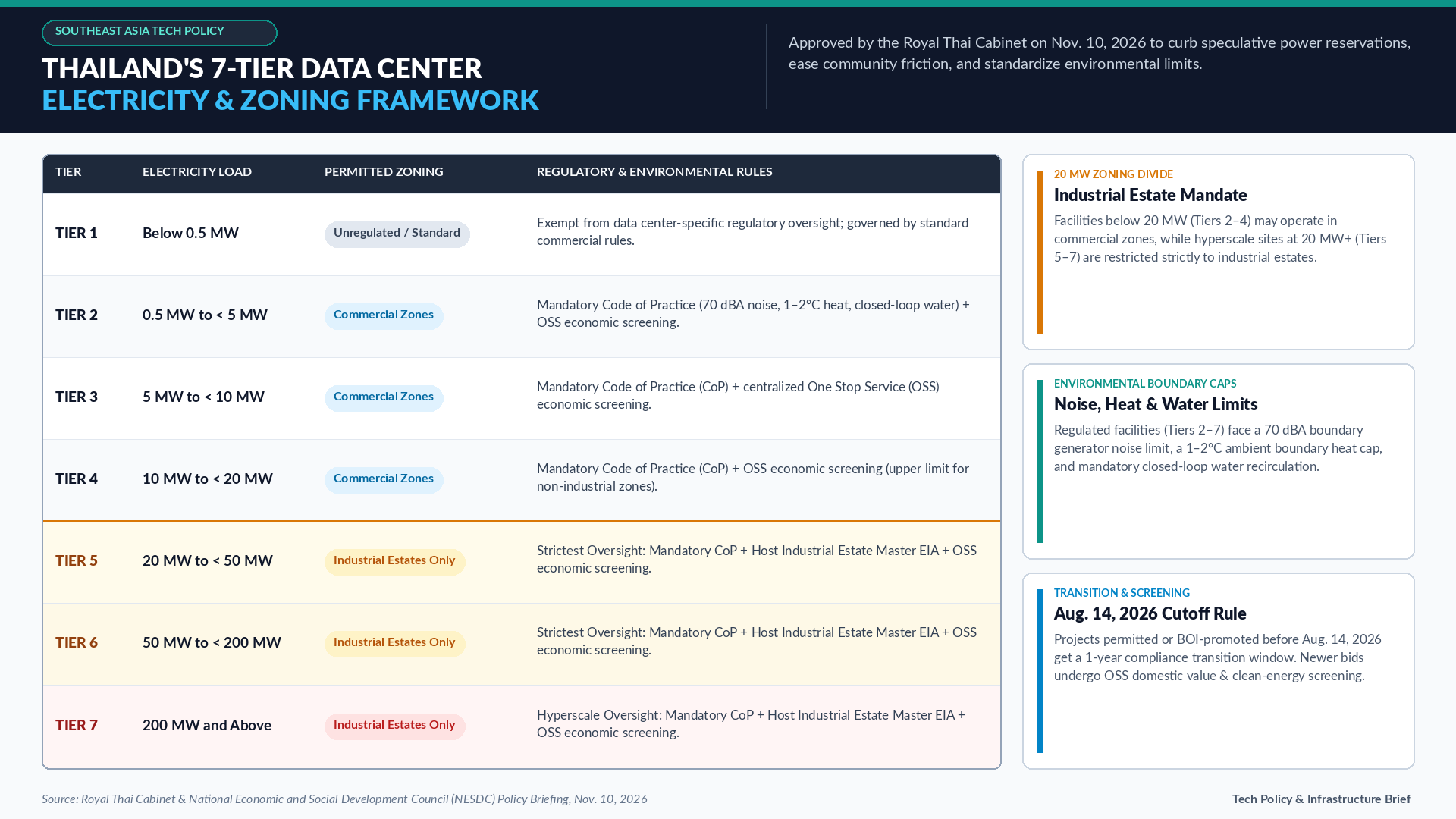
Facilities consuming at least 0.5 MW will fall under the regulatory framework, while those below the threshold will remain outside its data center-specific oversight.
The 20 MW threshold establishes the main zoning distinction. Facilities below that level may operate in commercial areas, subject to applicable requirements, while those consuming 20 MW or more must be located within industrial estates.
The framework also provides for a Code of Practice covering facilities within its scope, with requirements tailored to their size and operating conditions.
Electricity requests expose speculative project applications
The policy follows a surge in electricity requests from companies seeking to develop data centers in Thailand.
More than 110 applicants had requested over 30,000 megawatts (MW) of electricity, according to figures cited by Finance Minister and Deputy Prime Minister Ekniti Nitithanprapas. That amount represents more than half of Thailand’s approximately 55,000 MW generating capacity.
Officials estimated that only about a quarter or fewer of the applicants had genuine investment plans, raising concerns that speculative applications could tie up electricity and other resources needed by viable projects.
The government had already moved to pause development activity while it reviewed the sector’s regulatory requirements. In September, it temporarily froze 166 data center projects, including 49 under construction and 117 awaiting approval, according to the audit's cited AFP reporting.
The new framework is intended to give authorities a more coordinated way to assess project proposals and distinguish investment commitments from speculative requests for access to electricity and water.
Environmental standards set limits on noise, heat and water
The Cabinet-approved framework also establishes environmental requirements for data center operations.
Noise levels at facility boundaries are to be limited to approximately 70 A-weighted decibels (dBA) when backup power systems are operating. The framework also sets a limit of 1°C to 2°C for temperature increases at the boundary of a data center site.
Cooling water must be recirculated, while wastewater must undergo quality testing before it can be discharged. Facilities located within industrial estates will also be subject to the environmental requirements applicable to those areas.
The framework does not generally require standalone data centers to submit individual Environmental Impact Assessment (EIA) reports, according to Danucha. However, facilities located within industrial estates fall under the environmental assessment requirements governing their host estates.
New screening process prioritizes economic value
Beyond power consumption and environmental compliance, Thailand will assess data center proposals based on the economic benefits they can deliver domestically.
Projects with construction permits or Board of Investment (BOI) approvals issued before August 14, 2026, will be allowed a one-year transition period to meet the new environmental standards.
Applications submitted after that date will undergo additional economic screening through a centralized One Stop Service (OSS) mechanism. The assessment will consider factors such as local employment, skills development for Thai workers, domestic supply-chain participation, clean energy use and the recording of corporate income in Thailand.
The OSS is intended to coordinate the review of project applications and relevant government approvals, bringing information from different agencies into a more centralized process.
The approach reflects the government's stated objective of attracting data center investment while ensuring that projects contribute to Thailand's domestic economy and meet resource and environmental requirements.
A separate building regulation remains under review
The November 10 Cabinet framework should be distinguished from a separate draft building regulation being prepared by Thailand's Ministry of Interior under the Building Control Act of 1979.
The draft, which is scheduled for consideration by the Data Centre Board on November 27, groups facilities into building categories based on electricity consumption and reserve fuel storage capacity. It also includes technical requirements covering building safety, fire protection, emergency power systems and wastewater management.
Among its proposed provisions is a requirement for operators to treat and reuse at least 80% of monthly cooling-tower wastewater, known as blowdown. Wastewater not reused would have to meet government discharge standards before release.
If approved and subsequently published in the Royal Gazette, the draft regulation would take effect 180 days after publication. Its provisions are therefore separate from the Cabinet's November 10 policy framework and should not be treated as already implemented.
Thailand's regulatory approach comes as Southeast Asian economies compete to attract investment in the infrastructure supporting cloud computing, artificial intelligence and other data-intensive services.
For the Philippines and other countries seeking a greater role in emerging technology supply chains, the framework illustrates how governments can pair investment incentives with requirements governing energy, water, land use and local economic participation.
The distinction is particularly relevant as countries position themselves for potential participation in strategic technology and supply-chain initiatives, including Pax Silica. Attracting data center operators may bring investment and digital infrastructure, but large facilities also require reliable electricity, water, suitable sites and supporting infrastructure.
Thailand's policy makes those considerations part of the project approval process. Its tiered approach also provides a way to differentiate smaller facilities from hyperscale developments, rather than applying identical location requirements across the sector.
For prospective host countries, the policy raises questions about how to assess the actual readiness and economic contribution of proposed projects before allocating scarce infrastructure resources.
Balancing investment with resource limits
Thailand's November 10 decision establishes a more structured regulatory framework for data center development, linking project size to location requirements, environmental standards and economic screening.
The policy follows concerns that speculative electricity requests could complicate infrastructure planning as demand for AI and cloud computing facilities grows.
A separate building regulation remains under review, meaning some technical requirements are still subject to further approval and implementation.
The broader policy challenge for countries pursuing digital infrastructure investment is how to accommodate growing demand without allowing the resource requirements of individual projects to undermine wider development priorities.
 SHARE TO FACEBOOK
 SHARE TO TWITTER/X
 SHARE TO LINKEDIN
 SEND TO MAIL


