.svg)

.svg)

“We Don’t Have a Tech Problem. We Have a Societal Problem”: What the Platform-Blocking Petition Is Really Asking

The Philippines does not have a technology problem but a societal one that requires a different kind of response, Eliezer Rabadon reiterated during the Oct. 1 Unfiltered Roundtable with DICT Secretary Henry Aguda and other panelists.
Rabadon later reiterated the point in a social media post, saying that platforms can be banned but “hindi mawawala ang problema.”
“Lilipat lang sa ibang app—or people can simply vibe code their own messaging platform,” he wrote.
For Rabadon, the issue therefore goes beyond whether a particular platform should remain accessible. He pointed to discipline, parenting, respect and responsibility as factors that begin outside the technology itself.
“Discipline starts at home, not from banning platforms,” he wrote.
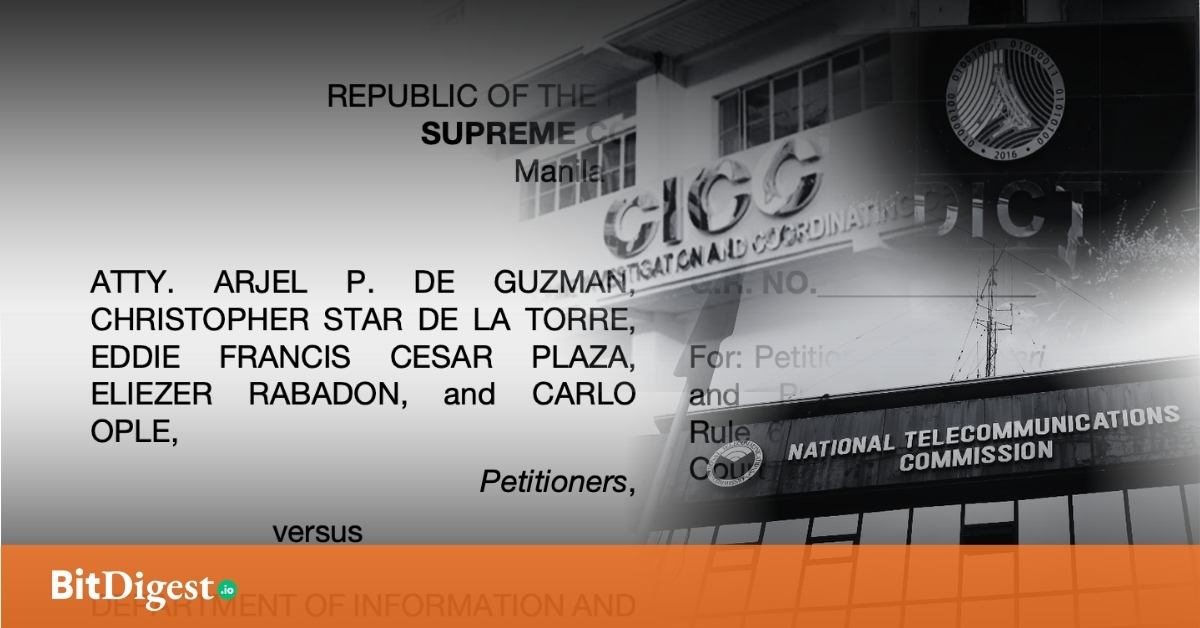
That distinction also provides context for a petition now before the Supreme Court challenging the Philippine government’s temporary nationwide blocking of Discord.
The petition does not make Rabadon’s broader argument about parenting or social discipline. Its focus is narrower: whether government agencies can impose a unilateral, wholesale and nationwide block on an online platform, and what government should have to establish before using such a sweeping measure.
At the center of the petition is a different question from simply whether platforms should be banned.
If the harm comes from specific unlawful activity, what is the appropriate way to address that activity without treating an entire platform and all of its users as the problem?
The petition does not argue that the underlying problems should be ignored
The government has cited concerns involving online sexual exploitation of children, child sexual abuse material, image-based sexual abuse, scams, illegal drug transactions, identity theft, account compromise, doxing, harassment and other unlawful activity in explaining its actions involving Discord.
The petition does not dispute that these are legitimate subjects of government enforcement. Instead, petitioners challenge the connection between those problems and the decision to block access to Discord nationwide.
They argue that the government did not identify particular incidents, affected servers or users, or continuing conduct that justified blocking access to the entire platform. They also argue that the government did not explain why narrower measures would have been inadequate.
The petition affirms that a platform can be used for unlawful activity without every account, server, file or conversation on that platform being unlawful, hence it argues that government enforcement should account for that difference.
If the harm is specific, the response should be specific
The petition repeatedly points to alternatives that would address particular conduct rather than disabling access to an entire service. These include targeted takedowns, account suspensions, preservation requests, disclosure orders and blocking of identified URLs, websites, accounts, files or content.
The argument is not that these measures will always be sufficient. Rather, petitioners contend that they should be considered and their adequacy assessed before government resorts to a platform-wide restriction.
The petition points to Discord’s own reported processes as evidence that more targeted mechanisms exist. It cites Discord’s 2026 transparency reporting, which recorded international legal requests and described the platform’s use of mutual legal assistance processes and case-by-case evaluation of emergency disclosure requests. It also points to thousands of preservation requests received by Discord globally.
The petition similarly cites restrictions carried out by Meta in response to government requests as another example of platform-level enforcement mechanisms. For the petitioners, these mechanisms matter because they provide ways to pursue suspected unlawful activity without automatically cutting off access for users who have no connection to it.
Government would have to show why broader measures are necessary
This is where the petition moves beyond the basic argument that a ban is too broad. Petitioners invoke strict scrutiny and argue that when fundamental freedoms are affected, government must show not only that it has a compelling interest but that the restriction is narrowly tailored and actually uses the least restrictive means available.
The petition specifically argues that it is not enough for authorities to merely contemplate alternatives. They should actively demonstrate why those alternatives would not work. The petition says that, to the extent practicable, this assessment should be supported by sound data-gathering mechanisms.
That changes the question from: “Is there a serious problem on the platform?” to “What evidence shows that blocking the entire platform is necessary to address that problem, rather than a narrower intervention?”
The petition also questions what government knew about the platform
Petitioners point to the government’s own statements following the Discord block. On Sept. 24, the Cybercrime Investigation and Coordination Center publicly apologized to affected users and acknowledged that Discord was used for education, work and business operations, rather than exclusively as a gaming communications platform. The petition quotes CICC Director Aya Macalma making that acknowledgment.
The petition uses that admission to support its argument that government could not adequately assess less restrictive alternatives without first understanding the nature and extent of the platform’s use. Its position is straightforward: if authorities do not have a sufficiently developed picture of what a platform is used for, it becomes harder to demonstrate that shutting down access to the entire service is the only effective way to address a particular threat.
The point is not that government must know every function of every platform before acting. It is that, according to the petition, the government bears a greater burden when the action affects an entire platform and millions of lawful users.
The problem with treating everyone as part of the same risk
The petition also frames the nationwide block as an equal-protection issue. It argues that Discord was singled out without an objective classification distinguishing it from other messaging, gaming, social-media, communications or community platforms that can also be used for unlawful activity.
Petitioners say the government did not establish that Discord was uniquely responsible for the cited activity, uniquely lacking in abuse-mitigation measures, uniquely unresponsive to Philippine authorities or uniquely without a Philippine legal representative.
The petition further argues that the restriction burdened lawful users who had no connection to the alleged violations. A nationwide block, by definition, does not distinguish between users suspected of unlawful conduct and people using Discord for ordinary purposes. The petition specifically identifies users who are not accused of or connected to the cited offenses as among those affected.
That includes the broader problem raised by Rabadon’s statement: removing access to a tool does not necessarily identify or change the people responsible for harmful behavior.
The petition is also about process
Even if a government agency determines that a serious and immediate threat exists, the petition argues that the method of restriction still has to satisfy due-process requirements.
Petitioners say the Discord blocking order did not provide particularized notice of the allegations, disclosure of evidence, a meaningful opportunity to respond, substantial-evidence findings, objective standards, or prompt and effective review.
They also challenge the absence of defined criteria for reviewing and lifting the restriction. The petition notes that the block was temporary, but argues that its 15-day duration does not by itself resolve the due-process question. It calls for a defined procedure through which affected parties can contest the factual findings, together with objective lifting criteria and a reasoned determination supported by evidence.
In other words, the petition is not asking only whether government has a legitimate reason to intervene. It is asking how that intervention is authorized, justified, challenged and eventually terminated.
A societal problem does not automatically become a platform problem
This is where Rabadon’s statement and the petition intersect without being the same argument. Rabadon’s position is about the nature of the problem.
A person can move from one application to another. A new messaging service can be created. Technology can change faster than any particular platform restriction. His broader point is that social behavior cannot be permanently corrected by removing one technological channel.
The petition takes that distinction into the legal and administrative sphere. Its argument is that if government is responding to unlawful activity occurring through a platform, it should identify the activity, establish the evidence supporting intervention, consider targeted enforcement mechanisms, demonstrate why narrower alternatives are inadequate where a broader restriction is proposed, and provide the procedural safeguards required when fundamental rights and lawful users are affected.
That does not mean government should do nothing. It means, according to the petition, that the existence of a serious societal problem does not by itself establish that disabling an entire technology is the appropriate remedy.
What the petition is actually asking the Supreme Court to do
The petition’s formal requests are narrower than the broader social discussion surrounding the Discord block. It asks the Supreme Court to annul and set aside the Sept. 23, 2026 NTC Memorandum and the Sept. 22 CICC Directive that ordered the nationwide blocking of Discord.
It also asks the Court to issue a writ of prohibition permanently restraining the respondents and those acting under their authority from implementing unilateral, wholesale and nationwide blocking of websites and social networking platforms through geofencing or equivalent access-blocking methods.
Finally, it asks the Court to declare that the respondents gravely abused their discretion in issuing the challenged orders. The petition therefore does not formally ask citizens to change how they use technology, nor does it prescribe a solution to the social problems Rabadon identifies.
Its demand is directed at government power. When the problem is serious, the response still has to be specific. When the restriction is broad, the justification has to be equally concrete. And when lawful users are swept into an enforcement action, the government has to account for them.
That is the legal question underneath Rabadon’s broader warning: a society may have a problem that technology helps facilitate, but turning off the technology is not necessarily the same thing as solving the problem.
.svg) SHARE TO FACEBOOK
SHARE TO FACEBOOK SHARE TO TWITTER/X
 SHARE TO LINKEDIN
 SEND TO MAIL




.svg)


.svg)