The ₱96-a-Day Illusion: How Millions of Filipinos Stopped Being "Poor" on Paper

If you walked into a public market today with ₱96 in your pocket, what could you buy?
A kilo of regular-milled rice, maybe an egg or two, and a couple of packets of instant noodles. By noon, your money is gone. You haven't paid for electricity, clean drinking water, your commute to work, rent, or school supplies for your kids.
Yet, according to the Philippine government’s official statistical metrics, if you spend more than ₱96.22 a day, you are officially not poor.
In August 2026, the Philippine Statistics Authority (PSA) released headline figures announcing a milestone: the proportion of poor Filipino families fell to a single-digit 6.4% in 2025, with individual poverty dropping to 9.7%. To many ordinary citizens feeling the daily pinch of high grocery bills and utility costs, this claim feels completely out of touch with reality.
The reason for this disconnect isn't bad arithmetic—it's how low the bar is set, and how quickly people can "clear" it on paper without experiencing any real change in their quality of life.
To understand official poverty figures, you have to look at the Annual Per Capita Poverty Threshold. This is the absolute minimum amount of money the state estimates an individual needs in a year to survive:
Per Person, Per Year: ₱35,121
Per Person, Per Day: ~₱96.22
For a Typical Family of 5: ~₱14,634 a month
This ₱96-a-day figure is not just for food; it covers everything—food, shelter, transportation, medicine, and utilities. If a five-member family brings home a combined ₱15,000 in a month, government ledgers classify them as "non-poor".
The Statistical Trick: Moving the Finish Line
The central mechanism behind the sudden drop in poverty lies in how the official baseline moves compared to reported incomes.
Imagine a high-jump competition where the bar is set at ankle height. As long as participants take a regular step, everyone clears it. That is what happened between 2023 and 2025:
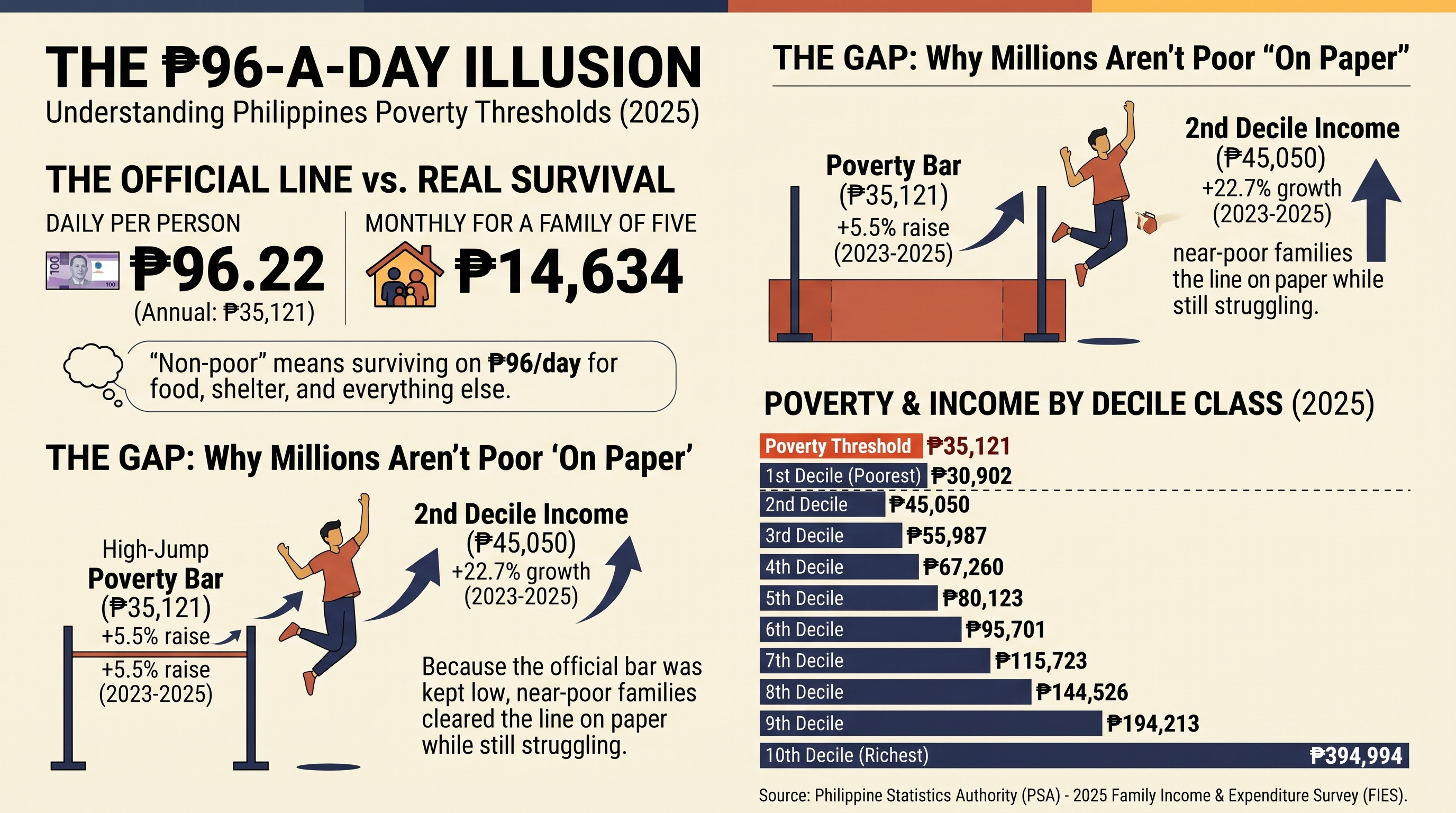
Between 2023 and 2025, the poverty bar was raised by only 5.5%. Over that same two-year span, cash inflows among the lower-income brackets—the second decile class—rose by 22.7%, reaching an average of ₱45,050 per person annually. Because the official bar crawled forward while nominal cash (boosted by minimal wage hikes, remittances, side hustles, or cash aid) took a modest step forward, the second income decile jumped past the ₱35,121 line.
Nominal Cash vs. Real-World Survival
Does an individual living on ₱45,050 a year (about ₱123 a day) live a comfortable, secure life?
Obviously not. A single health emergency, an unexpected rent increase, or a typhoon can wipe that margin out in an afternoon. Yet statistically, moving past that ₱35,121 threshold means hundreds of thousands of households were shifted out of the official "poor" column. They didn't escape hardship, debt, or food insecurity; they merely cleared an absolute subsistence line that has lagged far behind true living costs.
Why the Metric Persists
Economists and statisticians maintain this rigid threshold to preserve historical comparability: if you change the basket or raise the standard mid-stream, you disrupt the ability to track long-term economic series. However, measuring bare physical caloric survival is not the same as measuring human poverty. When policy benchmarks measure only whether a citizen can afford minimal daily calories rather than a dignified living wage, victory laps over "single-digit poverty" end up hiding the widespread economic vulnerability felt by the majority of Filipinos.
 SHARE TO FACEBOOK
 SHARE TO TWITTER/X
 SHARE TO LINKEDIN
 SEND TO MAIL