.svg)

.svg)
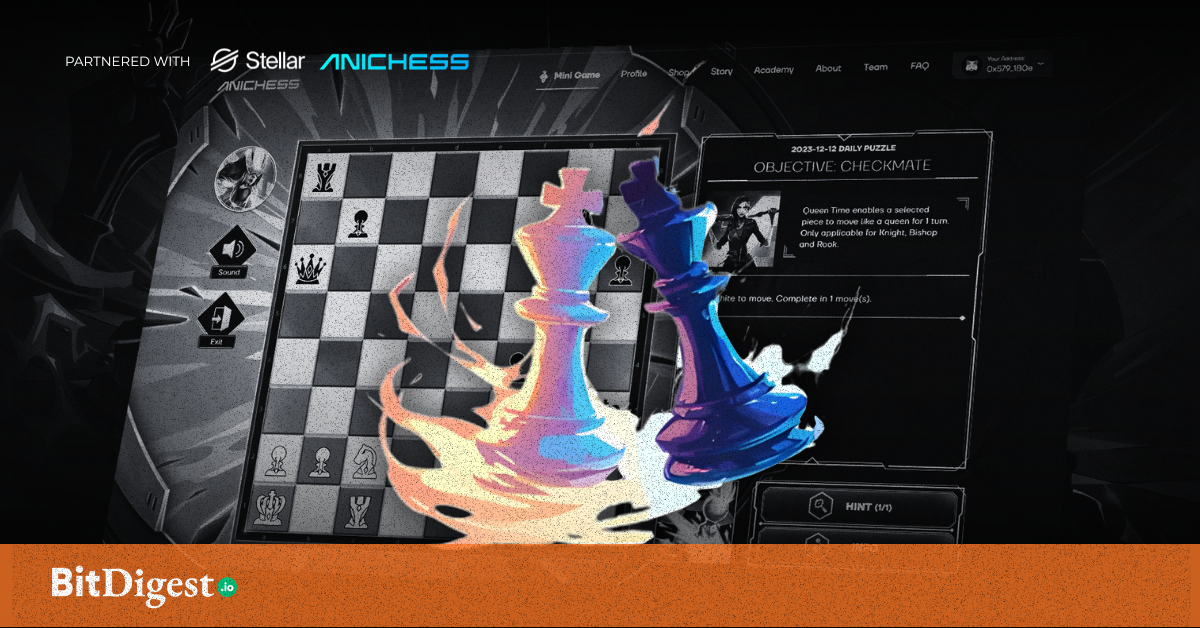
Anichess: Where Classic Strategy Meets Web3 Gameplay

In Web3, we’re used to seeing famous faces taped onto projects like stickers on a laptop. A celebrity tweets once, appears on a launch poster, maybe does a panel, and then disappears back into their real career.
For Anichess, Magnus Carlsen, five-time world champion and the closest thing chess has to a final boss, isn’t just an ‘associate’, he’s part of the project and publicly playing the game. In a space crowded with crypto games that seldom get meaningful playtime, that simple fact proves more than any token announcement could.
So what is Anichess?
Strip away the buzzwords and Anichess starts from something extremely familiar: online chess.
The project is a collaboration between Animoca Brands and Chess.com, the world’s biggest chess platform, which together set out to “modernize chess” rather than replace it. The pitch is simple: take the timeless rules of chess and add a spell layer on top.
Anichess describes itself as “infusing the timeless game with an innovative spell mechanic.” Players can solve spell-chess puzzles, face each other in matches, with their chosen spell rack and climb leaderboards by winning. The spells don’t throw out the rules of chess; they sit on top of them. You’re still playing with kings, queens, rooks, bishops, knights and pawns. But players also have limited-use abilities that can, for example, shield a piece, reshape a pawn structure, or turn a simple position into something much sharper.
The first public phase of Anichess, which launched in January 2024, was deliberately modest: a free, browser-based puzzle mode where players tackled daily spell-chess challenges rather than full competitive games. Only later did the team expand into a broader “online strategy game” with player-versus-player (PvP) matches, AI training opponents and unlockable spells.
Anichess didn’t burst out of nowhere demanding you play a brand-new genre; it started as “chess with a twist” you could try for free in your browser, then slowly added more ambitious modes around that core.
How it feels to play
For a chess or strategy-curious reader, the key question is: does this still feel like chess, or like something else entirely?
Most user feedback from players and reviewers resembles each other closely: it still feels like chess—just noisier, sharper and more tactical. Spells are limited resources. Using them at the wrong moment can be worse than not having them at all. That pushes players into a new kind of calculation: not just “what is the best move here?” but “is this the moment I burn a spell, or do I trust my position?”
Because the underlying movement rules remain intact, pattern recognition still transfers. Openings feel familiar. Endgames still reward good technique. What changes is the space in the middle: the messy, tactical middlegame where magic can suddenly flip the evaluation. Reviewers have pointed out that this makes Anichess surprisingly welcoming for both newcomers and veterans—new players get an experience suitable for modern games. And experienced ones get additional layers to think about without having to unlearn the classic game they know.
In other words, Anichess isn’t trying to replace chess. It’s trying to explore what happens if you add a second language on top of something millions of people already speak.
From small experiment to serious audience
In the months after launch, the project crossed more than one million registered players and maintained around 150,000 daily active users in its puzzle mode, with over 50 million spell-chess puzzles solved. When the broader public alpha went live in October 2024—adding PvP, AI training and more progression systems—those players didn’t vanish. Three months later, Anichess announced that it had already passed 100,000 monthly active users in December 2024, just on the new version.
By late 2025, tokenomics and ecosystem disclosures around Anichess referenced more than 340,000 players, around 100,000 monthly active users and millions of minutes of gameplay recorded in alpha version. None of those numbers, by themselves, make it the next League of Legends, but for a spell-chess variant built on Web3 rails, they’re a strong signal that this is more than a novelty.
Why this is the right place to start the story
There’s a lot more underneath Anichess: Web3 infrastructure, on-chain progression, tokens, points systems and a wider “Checkmate Ecosystem” trying to connect multiple strategy games. All of that deserves its own space.
But it’s important that the story doesn’t start there. What makes Anichess very interesting is how it took the most conservative, theory-heavy board game on the planet, layered in fantasy mechanics, quietly ran the whole thing on Web3 rails, and still convinced Magnus Carlsen to play, endorse and help shape it.
For chess and strategy-curious readers, that’s the real headline. Before we talk about tokens or on-chain economies, we should first answer a simpler question: What kind of game do you have to build for the best player in history to say, “this is a refreshing chess experience”?
Anichess is one possible answer. The next pieces in this series will look at how it blends the Web3 layer, how its economy is wired, and what its roadmap says about the future of onchain strategy games. For now, it’s enough to know that somewhere on the internet, you can load a browser, see a very normal-looking board, and discover that the guy on the other side might be the world champion; with a few spells up his sleeve.
.svg) SHARE TO FACEBOOK
SHARE TO FACEBOOK SHARE TO TWITTER/X
 SHARE TO LINKEDIN
 SEND TO MAIL




.svg)


.svg)