Think You Can Spot a Scam? Here Are 5 That Still Fool People

A majority of Filipinos feel equipped to identify fraudulent schemes, with 58% expressing confidence in their ability to detect them, based on findings from the Global Anti-Scam Alliance’s (GASA) State of Scams in the Philippines 2026 report. However, 84% still faced fraudulent attempts over the preceding year, resulting in total estimated losses reaching ₱121.8 billion.
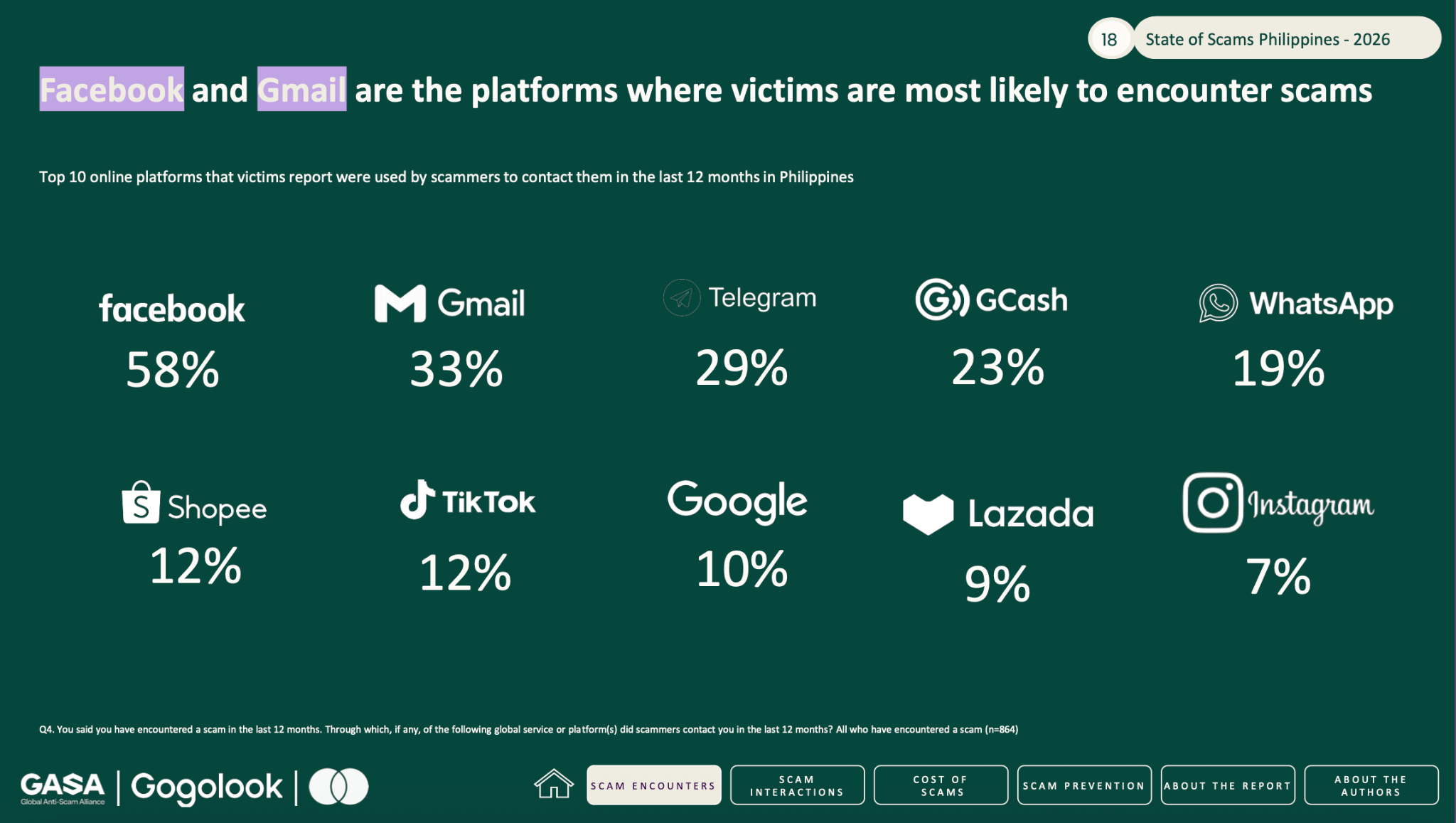
These interactions occur primarily across everyday communication channels, as 88% of fraudulent contacts take place on services offering direct messaging. Reports indicate that Facebook serves as the primary channel for these occurrences at 58%, followed by Gmail at 33%, Telegram at 29%, and GCash at 23%.
These schemes that work rarely look like scams. They borrow credibility from polished websites, early payouts, familiar faces, and official-looking documents, and none of which proves legitimacy.
Here are five scams worth understanding before trusting your hard-earned money to an unfamiliar platform.
1. Fake Investment Platforms
Some fraudulent investment platforms show realistic dashboards with account balances, profits, and transaction histories. They may even allow small withdrawals to make the returns look real.
Once users deposit larger amounts, withdrawals stall, unexpected charges appear, or more payments are demanded. A successful initial withdrawal doesn't prove the investment is legitimate.
2. AI Deepfake Investment Scams
With artificial intelligence (AI), scammers can manipulate videos and audio to impersonate recognizable personalities, creating endorsements that appear authentic.
This exploits a simple assumption: if a familiar and credible personality promotes something, the opportunity must be trustworthy. However, even a convincing video proves neither that the endorsement is genuine nor that the investment is legitimate.
3. Phishing and Banking Impersonation
Phishing messages impersonate banks and e-wallets, warning users about suspicious transactions or account restrictions.
These messages create urgency and redirect users to fraudulent websites designed to capture login credentials and sensitive information. The actual threat isn't necessarily the message itself, but the unauthorized account access that may follow.
4. Fake Job and Task Scams
These schemes offer simple online tasks with attractive compensation, sometimes providing small initial payments to establish credibility.
Eventually, users are required to deposit money to access higher-paying tasks or withdraw accumulated earnings. What initially appears to be employment becomes a system where victims must continually pay to access money they supposedly earned.
5. Fake Financial Institutions
Fraudulent operators may present corporate registration certificates, regulatory logos, or professional websites as evidence of legitimacy.
However, company registration doesn't automatically authorize an organization to solicit investments. Check whether it holds the authority required for the specific investment it is selling.
The common denominator is manufactured trust. Because modern transactions happen instantly, verifying offers first is more important than ever. Scammers rely on this speed, with 73% of fraud running through e-wallets and 88% using real-time transfers; and once funds are sent, it becomes difficult to recover.
So, before trusting an offer, verify the organization, its claims, and its regulatory status independently.
Only 4% of Filipino adults reported a scam to authorities in the past year. If you’re targeted, report the scam to the Cybercrime Investigation and Coordinating (CICC) hotline, 1326 or through their website scamwatchpilipinas.com.
For more financial awareness resources, visit https://blockshoals.com/learn.
 SHARE TO FACEBOOK
 SHARE TO TWITTER/X
 SHARE TO LINKEDIN
 SEND TO MAIL